Coordinate geometry becomes harder than it needs to be when you reach for a formula before understanding the diagram. A quick sketch can show whether you need a slope, a distance, a midpoint or an intersection.
The drawing does not need to be accurate to scale. It needs to keep the relationships clear while you translate them into algebra. The examples below show how to choose that translation.
Choose the method before calculating
Write down the objects you have: points, lines or a condition such as perpendicularity. For a line equation, check whether slope form is safe. A vertical line has no finite slope, so a method that divides by a coordinate difference needs care.
For a distance, the answer must be non-negative. For a section formula, decide whether the point divides the segment internally or externally before inserting a ratio.
Formula reference
These relationships need the conditions stated in the question. Check units, signs and any restrictions before substituting values.
Points and segments:
distance     d = sqrt((x2 - x1)^2 + (y2 - y1)^2)
midpoint     ((x1 + x2)/2, (y1 + y2)/2)
section m:n  ((m x2 + n x1)/(m + n), (m y2 + n y1)/(m + n))   internal
centroid     ((x1 + x2 + x3)/3, (y1 + y2 + y3)/3)
area         (1/2) |x1(y2 - y3) + x2(y3 - y1) + x3(y1 - y2)|
             area = 0  means the three points are collinear
Lines:
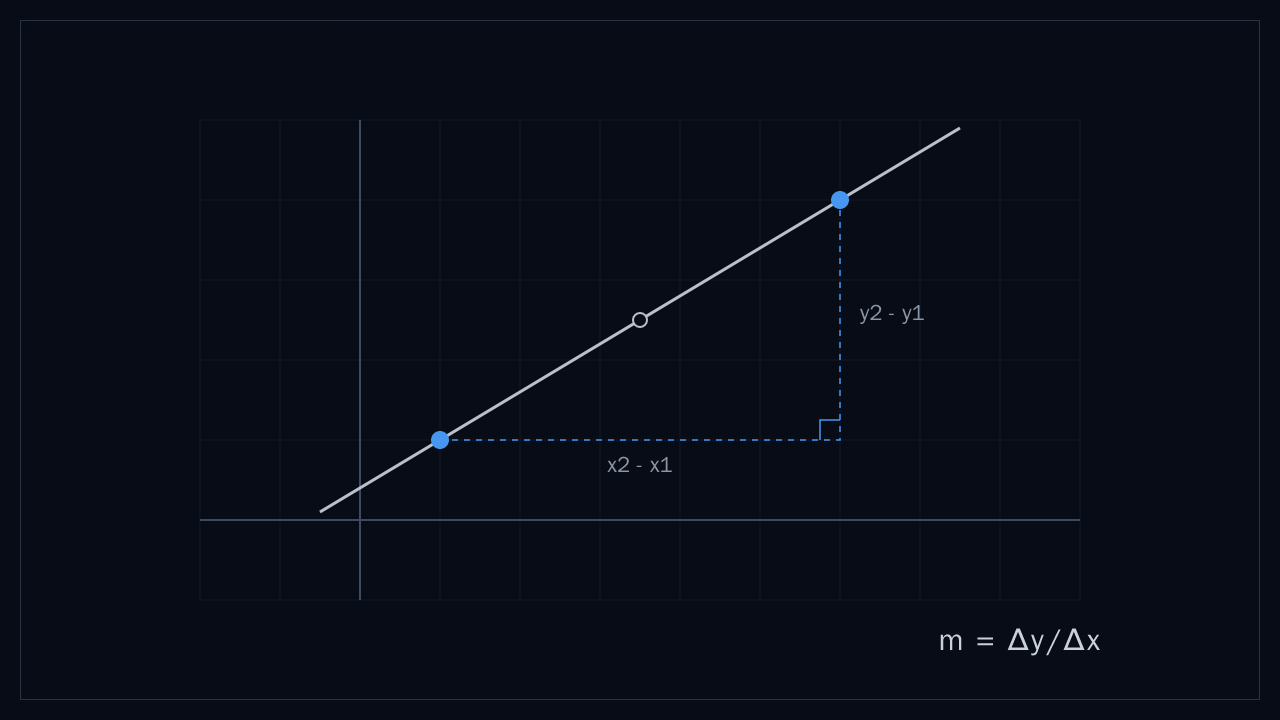
slope              m = (y2 - y1)/(x2 - x1) = tan(inclination)
slope of ax + by + c = 0        m = -a/b
point-slope        y - y1 = m(x - x1)
two-intercept      x/a + y/b = 1
normal form        x cos α + y sin α = p

parallel           m1 = m2
perpendicular      m1 m2 = -1
angle from l1 to l2   tan θ = (m2 - m1)/(1 + m1 m2)
Distances involving lines:
point to line            |a x0 + b y0 + c| / sqrt(a^2 + b^2)
parallel lines           |c1 - c2| / sqrt(a^2 + b^2)
(same a and b in both equations)
Change of axes:
translation, new origin (h, k):   X = x - h,  Y = y - k
rotation by θ:   X =  x cos θ + y sin θ
                 Y = -x sin θ + y cos θ
Worked examples
Try each question before reading its solution. These are preparation examples, not official NET questions.
1. Find the line through (-3, 5) perpendicular to x + 2y + 3 = 0.
The given line has slope -1/2, so the perpendicular slope is 2:
y - 5 = 2(x + 3)
2x - y + 11 = 0
2. Find the distance of (-7, 13) from 2x + y + 13 = 0.
|2(-7) + 13 + 13| / sqrt(4 + 1) = |12| / sqrt(5) = 12/sqrt(5)
3. The origin is shifted to (-4, -6). Where does P(-6, -8) move to?
X = -6 - (-4) = -2
Y = -8 - (-6) = -2
Answer: (-2, -2). The usual mistake is to add the shift instead of subtracting it.
4. In what ratio does the y-axis divide the segment from (-3, -4) to (1, -2)?
Every point on the y-axis has x = 0. Put that into the section formula with ratio m:n:
(m(1) + n(-3)) / (m + n) = 0
m = 3n,  so the ratio is 3:1
A faster way: the ratio is the distances of the two x-coordinates from zero, 3 and 1.
5. Find the distance between y = 2x + 4 and 3y = 6x - 5.
Both lines have slope 2, so they are parallel. Write them with the same a and b:
2x - y + 4 = 0
2x - y - 5/3 = 0
distance = |4 + 5/3| / sqrt(5) = (17/3)/sqrt(5) = 17/(3 sqrt(5))
Skip the rewrite and you will divide by sqrt(45) for one line and sqrt(5) for the other. That gives one of the wrong options.
Turn the examples into practice
Work through one question using both a sketch and algebra, then compare the results. In mixed sets, identify the relationship before calculating. Parallel and perpendicular conditions often remove options early.
Use analytical geometry practice, then move to conic sections. The maths formula sheet keeps the line and distance results together.
Sources and scope
- Use the official subject weightings to check whether this subject belongs to your NET category.
- NUST does not publish a guaranteed chapter question count. These examples are for learning methods, not predicting a paper.
Source: HSSC textbook topics and SailToNUST practice material; NUST subject weightings reviewed October 2026
FAQ
Is analytical geometry hard in NET?
What is the difference between analytical geometry and conic sections?
How do I find the angle between two lines quickly?
tan θ = (m2 - m1)/(1 + m1 m2). If 1 + m1 m2 = 0 the lines are perpendicular and the angle is 90°.