The graph may look complicated, but a functions question often turns on a simple restriction: a denominator cannot be zero, a real square root needs a non-negative input, or an inverse needs a suitable domain.
This guide starts with those restrictions and then moves to composition, inverses and graph changes. Sketching a few points can be more useful than trying to remember every graph as a separate picture.
Choose the method before calculating
Find the domain before manipulating the function. Simplifying an expression does not automatically restore an input that the original expression excluded. For a composition, check that the output of the inner function is allowed as an input of the outer one.
For transformations, test a familiar point. In f(x - a), the horizontal movement can feel backwards if you only memorise a phrase. Substituting one point makes the direction concrete.
Formula reference
These relationships need the conditions stated in the question. Check units, signs and any restrictions before substituting values.
Domain rules. Find what breaks the formula and exclude it:
sqrt(g(x))   needs  g(x) >= 0
1 / g(x)     needs  g(x) ≠ 0
ln g(x)      needs  g(x) > 0
Inverse and composition:
To find f^-1: write y = f(x), swap x and y, solve for y
f(f^-1(x)) = x   and   f^-1(f(x)) = x
(f o g)(x) = f(g(x))      usually ≠ g(f(x))

For f(x) = (ax + b)/(cx + d):
f^-1(x) = (dx - b)/(a - cx)
Graph transformations, for y = f(x):
y = f(x) + k     shift up by k
y = f(x - h)     shift right by h
y = -f(x)        reflect in the x-axis
y = f(-x)        reflect in the y-axis
y = a f(x)       stretch vertically by a
Even and odd: f(-x) = f(x) means even, with the graph symmetric about the y-axis. f(-x) = -f(x) means odd, with the graph symmetric about the origin.
Counting functions between finite sets, with n(A) = m and n(B) = n:
all functions A -> B         = n^m
one-to-one functions A -> B  = nPm    (needs m <= n)
Worked examples
Try each question before reading its solution. These are preparation examples, not official NET questions.
1. Find the domain of y = sqrt(-x).
The square root needs -x >= 0, so x <= 0. Domain: (-infinity, 0]. Students who see a minus sign and assume "no real domain" lose this one.
2. If f(x) = (3x + 1)/(2x - 1), find f^-1(x) and f^-1(2).
Use the shortcut with a = 3, b = 1, c = 2, d = -1:
f^-1(x) = (-x - 1)/(3 - 2x) = (x + 1)/(2x - 3)
f^-1(2) = 3/1 = 3
Check: f(3) = 10/5 = 2. Correct.
3. If h(x) = 3x + 2 and h(f(x)) = x, find f(2).
h(f(x)) = x means f is the inverse of h. So f(x) = (x - 2)/3 and f(2) = 0.
4. If f(x) = x^2 + 1 and g(x) = 2x - 3, find f(g(2)) and g(f(2)).
g(2) = 1,  so f(g(2)) = f(1) = 2
f(2) = 5,  so g(f(2)) = g(5) = 7
The two answers differ, and MCQs often list both as options. Work from the inside out.
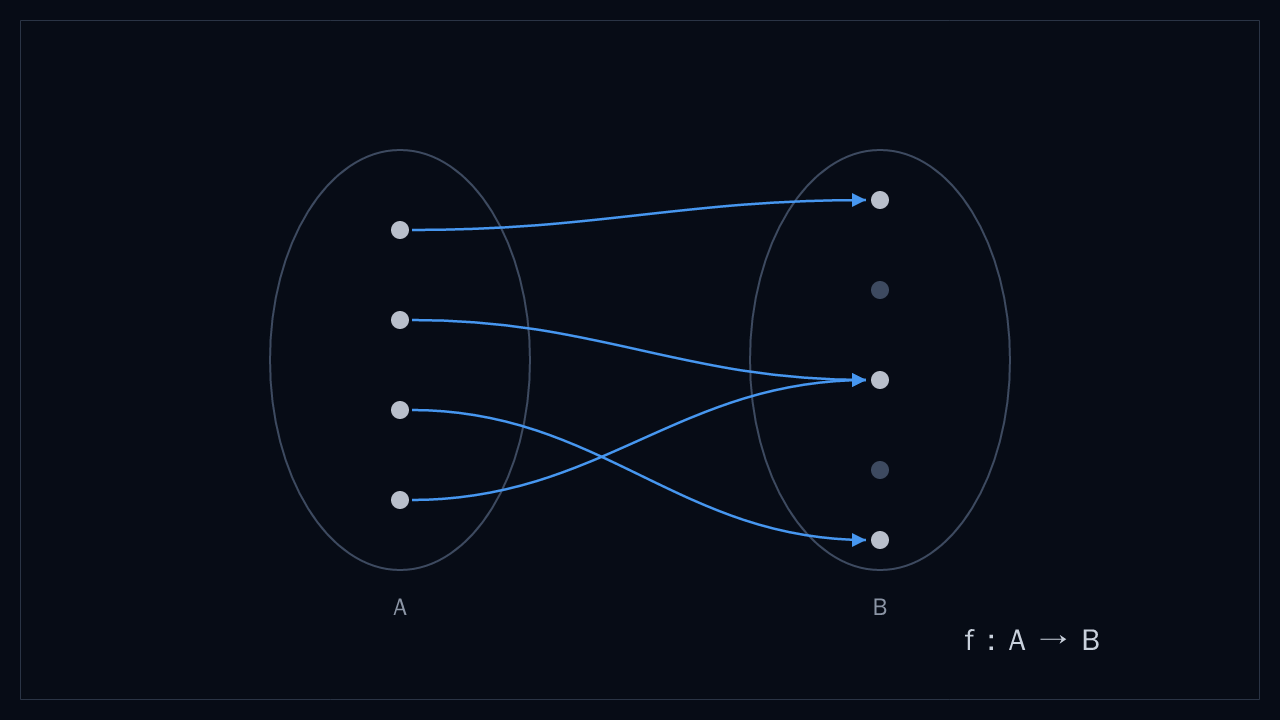
5. Let L = {1, 2, 3}, M = {1, 2, 3, 4, 5, 6} and f(x) = 2x from L to M. What type of function is f?
The images are 2, 4 and 6. No two inputs share an output, so f is one-to-one. The values 1, 3 and 5 in M are never hit, so f is not onto. Answer: injective only.
Turn the examples into practice
Alternate symbolic questions with rough sketches. Explain why an inverse is or is not a function on the stated domain, and identify range from the actual outputs rather than the form of the expression alone.
Use functions practice, then read limits and continuity. The maths guide connects these ideas to calculus.
Sources and scope
- Use the official subject weightings to check whether this subject belongs to your NET category.
- NUST does not publish a guaranteed chapter question count. These examples are for learning methods, not predicting a paper.
Source: HSSC textbook topics and SailToNUST practice material; NUST subject weightings reviewed October 2026
FAQ
Are sets and binary operations included in NET maths?
How do I find the range of a function quickly?
(ax + b)/(cx + d), every value except a/c is in the range, as long as c is not zero.