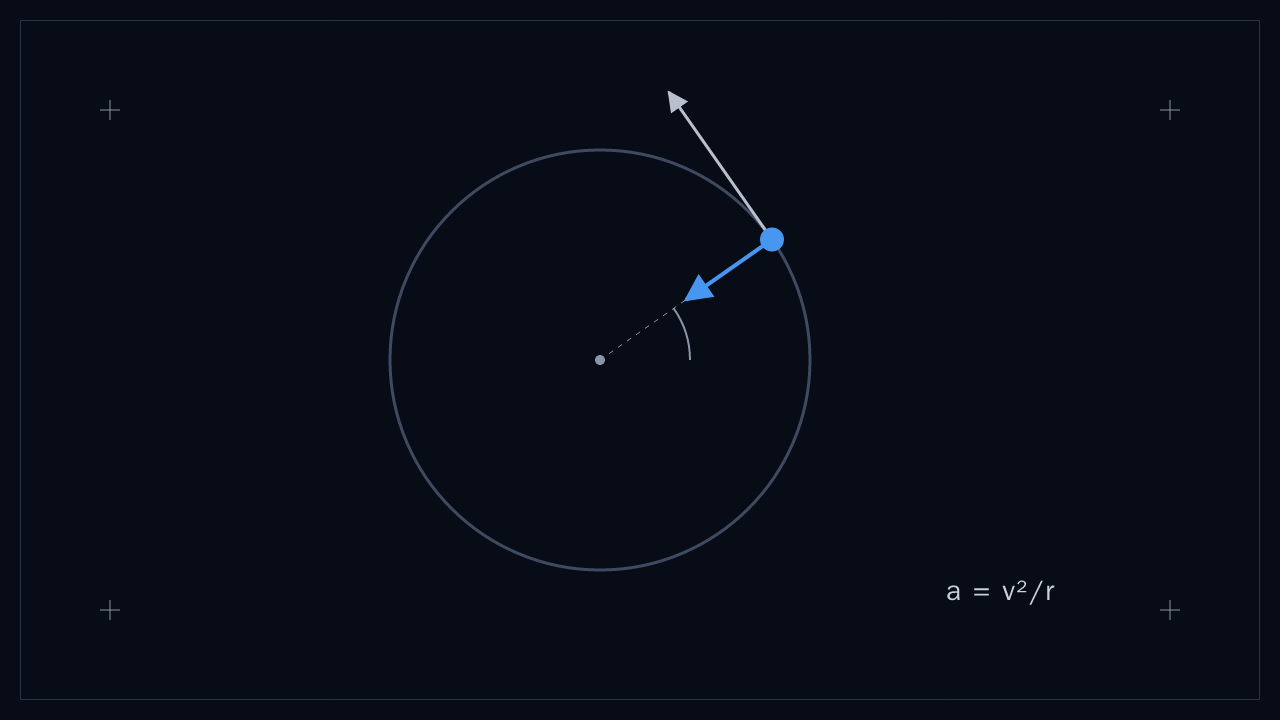
An object moving at constant speed can still accelerate if its direction changes. That idea connects the circular-motion formulas and explains why "centripetal force" is a role played by a real force, rather than an extra force to add to a diagram.
Rotational questions extend the same reasoning to angular quantities. Keep the linear and angular descriptions connected instead of learning two unrelated lists.
Choose the method before calculating
For circular motion, draw the inward radial direction and identify which forces supply the required acceleration. Tension, gravity and friction can each play that role in different problems.
For rotation, write the axis before choosing a moment of inertia. In rolling questions, check whether the no-slip condition applies before relating linear and angular speed.
Formula reference
These relationships need the conditions stated in the question. Check units, signs and any restrictions before substituting values.
ω = 2π / T = 2πf                     rad s⁻¹
rev/min to rad/s: multiply by 2π/60

Centripetal acceleration   a_c = v²/r = rω²      m s⁻²
Centripetal force          F_c = mv²/r = mrω²    N

Moments of inertia (axis through centre)
ring / hoop     I = MR²
disc            I = ½MR²
solid sphere    I = ⅖MR²
rod (centre)    I = ML²/12

Conservation of angular momentum   I₁ω₁ = I₂ω₂

Rolling down a slope from height h (starting at rest)
v = √(2gh / (1 + I/MR²))
hoop: v = √(gh)    disc: v = √(4gh/3)    sphere: v = √(10gh/7)

Orbital speed              v = √(GM/r); near Earth's surface √(gR) ≈ 7.9 km s⁻¹
Geostationary satellite    period 24 h, about 36,000 km above the equator
Connecting linear and angular quantities
| Linear | Rotational | Link |
|---|---|---|
| displacement s (m) | angle θ (rad) | s = rθ |
| velocity v (m/s) | angular velocity ω (rad/s) | v = rω |
| acceleration a | angular acceleration α | a_t = rα |
| mass m | moment of inertia I (kg m²) | I = Σmr² |
| force F | torque τ (N m) | τ = rF sinθ |
| momentum p = mv | angular momentum L = Iω | L = mvr for a point mass |
| F = ma | τ = Iα | |
| KE = ½mv² | KE = ½Iω² |
If you remember this table, you can rebuild every equation in the chapter from the linear one you already know.
Worked examples
Try each question before reading its solution. These are preparation examples, not official NET questions.
1. Wheel turning once a second. A cycle wheel of radius 0.4 m completes one revolution every second. What is the centripetal acceleration of a point on its rim?
(a) 0.4π m/s² (b) 0.8π m/s² (c) 0.4π² m/s² (d) 1.6π² m/s²
ω = 2π / T = 2π rad/s
a = rω² = 0.4 × 4π² = 1.6π² m/s²  (about 15.8 m/s²)
Answer (d). Option (b) is the rim speed v = rω = 0.8π m/s, not the acceleration.
2. Halving the radius at fixed ω. A particle moves in a circle at constant angular velocity with angular momentum L. The radius is halved while ω stays the same. What is the new angular momentum?
(a) L/4 (b) L/2 (c) L (d) 2L
L = mvr = m(rω)r = mr²ω
r → r/2  so  L → L/4
Answer (a). The common wrong answer is L/2, from treating v as fixed. Here ω is fixed, so v halves too.
3. Energy in a spinning wheel. A heavy wheel with I = 2 kg m² spins at 300 rev/min. What is its rotational kinetic energy?
(a) 100 J (b) 300 J (c) 987 J (d) 9000 J
ω = 300 × 2π / 60 = 10π rad/s
KE = ½Iω² = ½ × 2 × (10π)² = 100π² ≈ 987 J
Answer (c). If you leave ω in rev/min you get 90,000 J. If you convert to rev/s but forget 2π you get 25 J. Both make good distractors, so expect to see one of them in the options.
4. Disc versus hoop on a slope. A disc and a hoop of the same mass and radius roll from rest down a slope of vertical height 1.8 m. With g = 10 m/s², what is the disc's speed at the bottom, and which reaches the bottom first?
disc: v = √(4gh/3) = √(4 × 10 × 1.8 / 3) = √24 ≈ 4.9 m/s
hoop: v = √(gh)    = √18                  ≈ 4.2 m/s
The disc arrives first at about 4.9 m/s. The hoop puts more of its energy into spinning because all its mass sits at the rim. Mass and radius cancel out, so a small disc beats a big hoop every time.
5. Car on a flat bend. A 1000 kg car takes a flat bend of radius 50 m at 20 m/s. What sideways friction force must the road provide?
(a) 400 N (b) 4000 N (c) 8000 N (d) 20,000 N
F = mv²/r = 1000 × 400 / 50 = 8000 N
Answer (c). Double the speed and the force goes up four times. That is why speed limits on bends matter more than on straights.
Turn the examples into practice
Practise identifying the inward force before calculating its size. Then mix questions on angular speed, torque and rolling so you must choose the right relationship.
Use circular-motion practice, review force diagrams, and keep the physics formula sheet for checking symbols and units.
Sources and scope
- Use the official subject weightings to check whether this subject belongs to your NET category.
- NUST does not publish a guaranteed chapter question count. These examples are for learning methods, not predicting a paper.
Source: HSSC textbook topics and SailToNUST practice material; NUST subject weightings reviewed October 2026