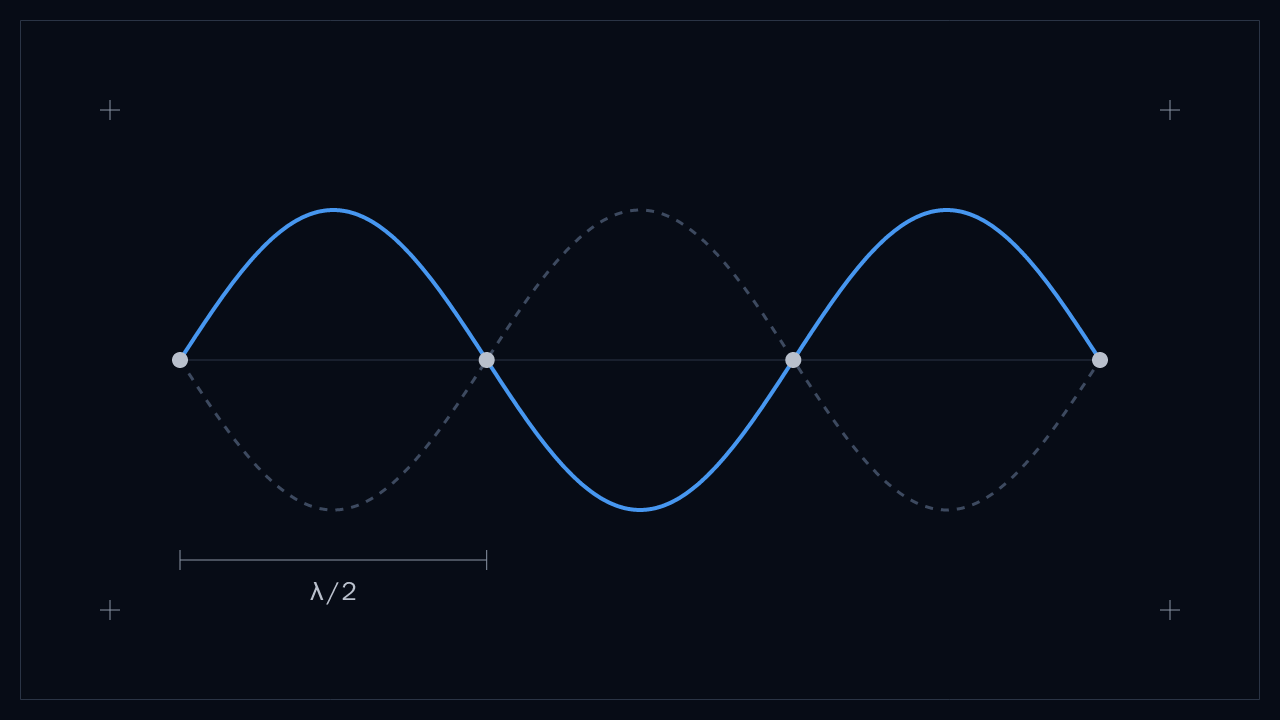
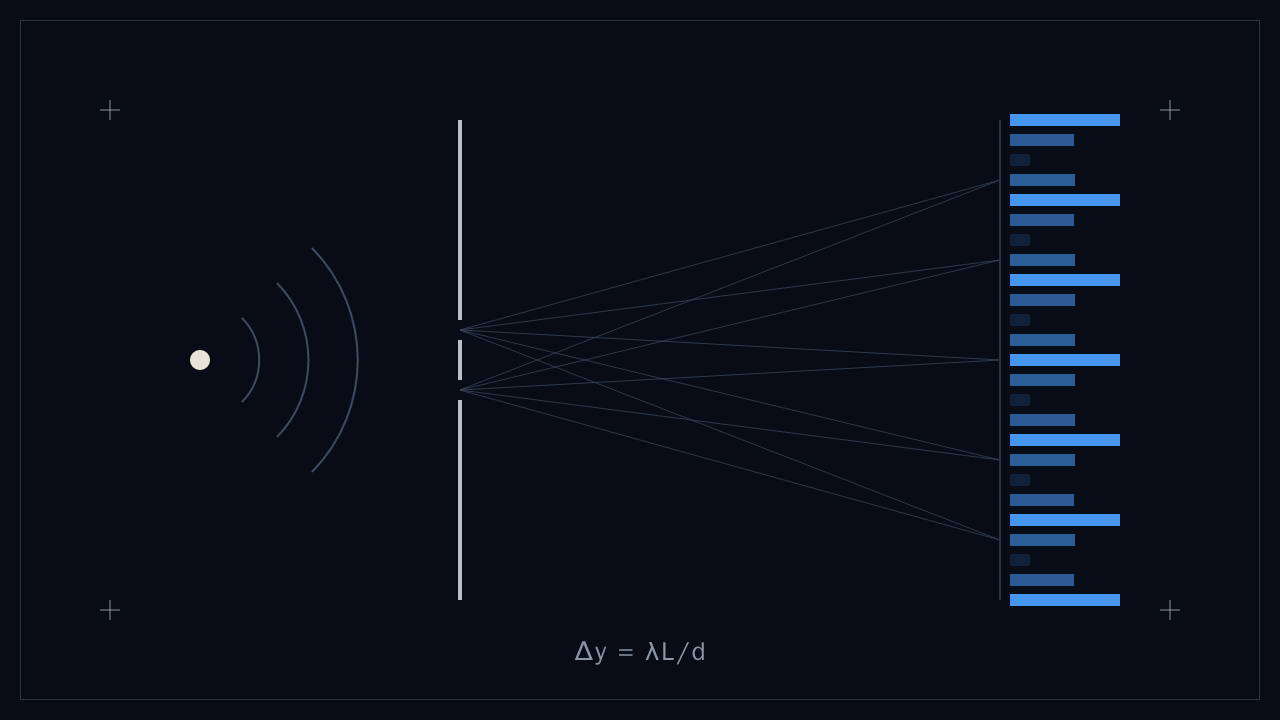
An interference pattern is easier to understand when you think about path difference before memorising bright-fringe and dark-fringe conditions. The pattern changes because waves arrive with different relative phases.
This guide connects that idea to the usual calculations. Keep the experimental arrangement in view, because a formula for a double slit cannot be applied blindly to every diffraction question.
Choose the method before calculating
Sketch the source, slits or aperture and the screen. Identify the approximation behind the formula, then check whether the question asks for a position, spacing or angle.
When a wavelength changes, track which other quantities stay fixed. For polarisation, distinguish an unpolarised incident beam from light that has already passed through a polariser.
Formula reference
These relationships need the conditions stated in the question. Check units, signs and any restrictions before substituting values.
Coherent sources: same frequency and a constant phase difference

Path difference
constructive (bright)   Δ = mλ          m = 0, 1, 2 ...
destructive (dark)      Δ = (m + ½)λ

Young's double slit (slit gap d, screen distance L)
bright fringe position  yₘ = mλL / d
fringe width            Δy = λL / d       m

Single slit (width a), minima      a sinθ = mλ     m = 1, 2, 3 ...
Diffraction grating                d sinθ = mλ     m = 0, ±1, ±2 ...
  grating element d = 1 / N   (N = lines per metre)
  highest order seen  m less than d/λ  (round down)
Bragg's law (X-rays on a crystal)  2d sinθ = nλ   (θ = glancing angle)

Polarization
unpolarized light through one polarizer     I = I₀ / 2
Malus's law                                 I = I₀ cos²θ
Brewster angle                              tan θ_B = n

1 nm = 10⁻⁹ m,  1 Å = 10⁻¹⁰ m
Worked examples
Try each question before reading its solution. These are preparation examples, not official NET questions.
1. Changing L and d. In Young's experiment, the slit-to-screen distance is doubled and the slit separation is halved. What happens to the fringe width?
(a) doubles (b) becomes four times (c) halves (d) stays the same
Δy = λL / d
L → 2L, d → d/2   so  Δy → (2/(1/2)) Δy = 4Δy
Answer (b).
2. Fringe width with numbers. Light of wavelength 600 nm falls on slits 0.3 mm apart. The screen is 1.5 m away. What is the fringe width?
(a) 0.3 mm (b) 3 mm (c) 30 mm (d) 0.03 mm
Δy = λL / d = (600 × 10⁻⁹ × 1.5) / (0.3 × 10⁻³)
   = 9 × 10⁻⁷ / 3 × 10⁻⁴ = 3 × 10⁻³ m = 3 mm
Answer (b). Convert both nm and mm to metres before dividing. Mixing them is the usual source of a factor-of-1000 error.
3. Grating orders. A grating has 5000 lines per cm. Light of wavelength 500 nm falls on it normally. At what angle is the first-order maximum, and what is the highest order you can see?
N = 5000 per cm = 5 × 10⁵ per m
d = 1/N = 2 × 10⁻⁶ m
first order:  sinθ = λ/d = 5 × 10⁻⁷ / 2 × 10⁻⁶ = 0.25   →  θ ≈ 14.5°
d/λ = 4, but m = 4 needs sinθ = 1 (θ = 90°), which lies along the grating
highest visible order = 3
This is the grating trap. When d/λ comes out as a whole number, that order sits at 90° and you cannot see it. Round down, and if the result is exact, subtract one.
4. Bragg diffraction. X-rays strike a crystal with atomic spacing 2 × 10⁻¹⁰ m at a glancing angle of 30°. First-order diffraction is observed. What is the wavelength?
(a) 4 × 10⁻¹⁰ m (b) 2 × 10⁻¹⁰ m (c) 1 × 10⁻¹⁰ m (d) 0.5 × 10⁻¹⁰ m
2d sinθ = nλ
λ = 2 × 2 × 10⁻¹⁰ × 0.5 / 1 = 2 × 10⁻¹⁰ m
Answer (b). The angle in Bragg's law is measured from the crystal plane, not from the normal. If a question gives the angle of incidence from the normal, use 90° minus it.
5. Two polarizers. Unpolarized light of intensity I₀ passes through two polarizers whose axes are 60° apart. What intensity comes out?
(a) I₀/2 (b) I₀/4 (c) I₀/8 (d) 3I₀/8
after first polarizer:   I₀ / 2
after second:            (I₀ / 2) × cos²60° = (I₀ / 2) × ¼ = I₀ / 8
Answer (c). Option (b) forgets the first halving. Option (d) uses sin² instead of cos².
Turn the examples into practice
Practise predicting the direction of a change before calculating the new spacing or intensity. If your number contradicts the prediction, recheck the setup and units.
Use optics practice, revisit waves for phase reasoning, and keep the physics reference sheet nearby during review.
Sources and scope
- Use the official subject weightings to check whether this subject belongs to your NET category.
- NUST does not publish a guaranteed chapter question count. These examples are for learning methods, not predicting a paper.
Source: HSSC textbook topics and SailToNUST practice material; NUST subject weightings reviewed October 2026