Quantum-physics questions often ask you to distinguish an individual photon's energy from the total energy arriving in a beam. Changing intensity and changing frequency do different things in a photoelectric experiment.
Prepare this chapter by connecting each formula to what the experiment measures. That makes it easier to reject an answer that has the right units but describes the wrong physical effect.
Choose the method before calculating
For photoelectric emission, compare photon energy with the work function before calculating kinetic energy. More low-frequency photons do not overcome a threshold that each photon fails to reach.
For de Broglie questions, identify the momentum and check whether the non-relativistic relationship applies. Convert electron-volts and joules explicitly when mixing electrical and mechanical quantities.
Formula reference
These relationships need the conditions stated in the question. Check units, signs and any restrictions before substituting values.
Photon energy          E = hf = hc/λ          h = 6.63 × 10⁻³⁴ J s
Shortcut               E (eV) = 1240 / λ (nm)
Photon momentum        p = h/λ = E/c
1 eV = 1.6 × 10⁻¹⁹ J

Black body
Wien's law             λ_max T = 2.9 × 10⁻³ m K
Stefan's law           E = σT⁴               σ = 5.67 × 10⁻⁸ W m⁻² K⁻⁴

Photoelectric effect   hf = φ + K_max
                       K_max = eV₀  (V₀ = stopping potential)
                       threshold frequency f₀ = φ/h

Compton shift          Δλ = (h / m₀c)(1 − cosθ)
                       h / m₀c = 2.43 × 10⁻¹² m  (Compton wavelength)

de Broglie             λ = h/p = h/mv = h/√(2mK)
electron through V volts   λ ≈ 1.23/√V nm

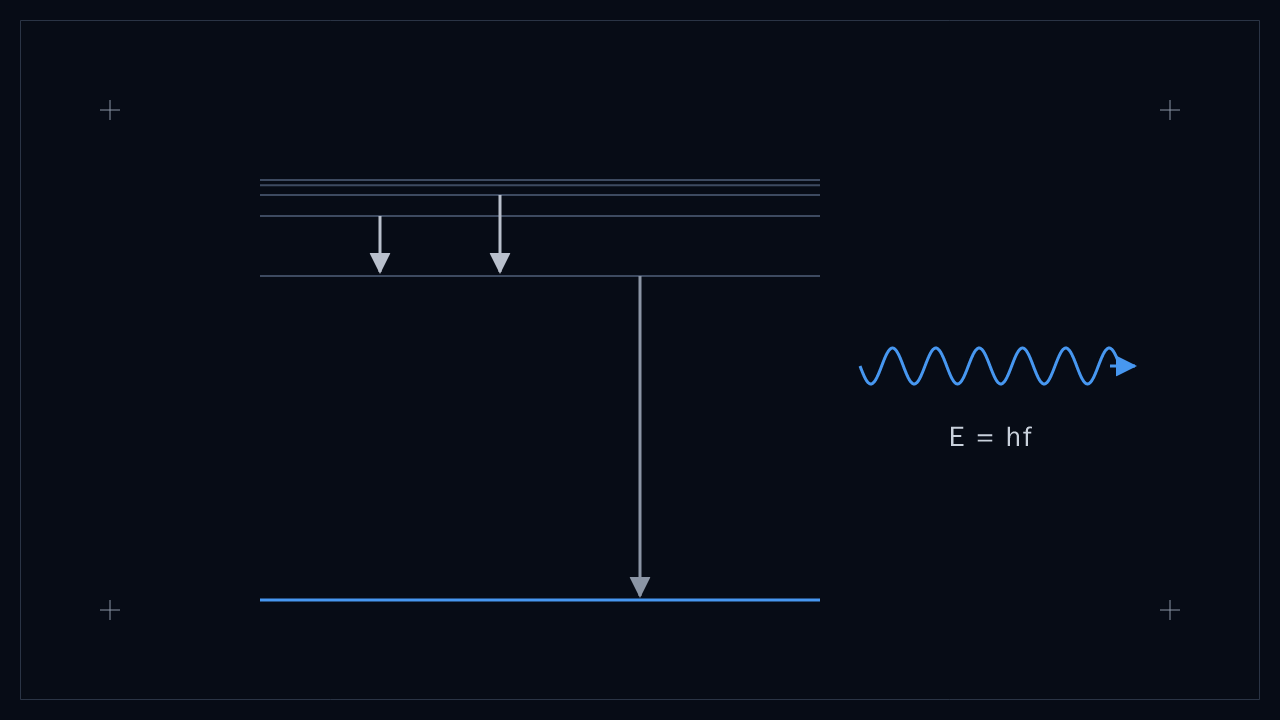
Hydrogen (Bohr)        Eₙ = −13.6/n² eV,  rₙ = n² × 0.053 nm
Spectral lines         1/λ = R_H (1/n₁² − 1/n₂²),  R_H = 1.097 × 10⁷ m⁻¹
Series ending on n₁:   1 Lyman (UV), 2 Balmer (visible), 3 Paschen,
                       4 Brackett, 5 Pfund (infrared)

X-ray tube cut-off     λ_min = hc / eV
Pair production        needs at least 1.02 MeV
Uncertainty            Δx Δp ≥ h/4π  (your textbook may write Δx Δp ≈ h)
Worked examples
Try each question before reading its solution. These are preparation examples, not official NET questions.
1. X-ray cut-off wavelength. An X-ray tube runs at 30 kV. What is the shortest wavelength it emits?
(a) 2840 Å (b) 0.413 Å (c) 2.14 Å (d) 1.78 Å
Photon energy max = 30 keV = 30,000 eV
λ_min = 1240 / 30,000 nm = 0.0413 nm = 0.413 Å
Answer (b). 1 nm is 10 Å, which is the conversion people forget at the last step.
2. Stopping potential. Light of wavelength 300 nm falls on a metal with work function 2.5 eV. What is the stopping potential?
(a) 4.13 V (b) 2.5 V (c) 1.63 V (d) 6.63 V
E = 1240 / 300 = 4.13 eV
K_max = 4.13 − 2.5 = 1.63 eV
V₀ = 1.63 V
Answer (c). In electron-volts, K_max and the stopping potential have the same number. That saves a conversion.
3. Compton angle. The Compton shift equals half the Compton wavelength. What is the scattering angle?
(a) 30° (b) 60° (c) 90° (d) 120°
Δλ = (h/m₀c)(1 − cosθ) = ½ (h/m₀c)
1 − cosθ = ½  so  cosθ = ½  so  θ = 60°
Answer (b). The shift is largest at 180°, where it equals twice the Compton wavelength.
4. The red hydrogen line. An electron in hydrogen drops from n = 3 to n = 2. What wavelength is emitted?
(a) 122 nm (b) 486 nm (c) 656 nm (d) 1875 nm
ΔE = 13.6 (1/4 − 1/9) = 13.6 × 5/36 ≈ 1.89 eV
λ = 1240 / 1.89 ≈ 656 nm
Answer (c). It ends on n = 2, so it belongs to the Balmer series and is visible red light. 122 nm is the first Lyman line (2 to 1). 1875 nm is the first Paschen line (4 to 3).
5. Electron wavelength. An electron is accelerated from rest through 100 V. What is its de Broglie wavelength?
(a) 0.0123 nm (b) 0.123 nm (c) 1.23 nm (d) 12.3 nm
λ = h / √(2meV)
  = 6.63 × 10⁻³⁴ / √(2 × 9.11 × 10⁻³¹ × 1.6 × 10⁻¹⁹ × 100)
  = 6.63 × 10⁻³⁴ / 5.4 × 10⁻²⁴ ≈ 1.23 × 10⁻¹⁰ m = 0.123 nm
Answer (b). With the shortcut, 1.23/√100 = 0.123 nm in one line. That is about the spacing of atoms in a crystal, which is why electron diffraction works.
Turn the examples into practice
Use short explanation questions as well as numerical ones. Describe what happens when frequency increases at fixed intensity, then check your reasoning against the equations.
Try quantum practice, continue to nuclear physics, and use the formula sheet to keep constants and units consistent.
Sources and scope
- Use the official subject weightings to check whether this subject belongs to your NET category.
- NUST does not publish a guaranteed chapter question count. These examples are for learning methods, not predicting a paper.
Source: HSSC textbook topics and SailToNUST practice material; NUST subject weightings reviewed October 2026