A derivative question can look familiar and still go wrong because of one missing inner factor. In NET preparation, differentiation is worth learning as a set of decisions: identify the function, choose the rule and check what else changes with x.
This guide works through those decisions before you add speed. The formula list is a reference, and the examples show where an apparently small detail changes the answer.
Choose the method before calculating
Before taking a derivative, name the structure aloud: a product, a quotient, a function inside another function, or a parametric curve. This takes practice, but it prevents the common habit of applying the power rule to everything.
For a chain rule question, identify the outer and inner functions separately. For a second parametric derivative, remember that differentiating with respect to t is only an intermediate step. You must convert back to differentiation with respect to x.
Formula reference
These relationships need the conditions stated in the question. Check units, signs and any restrictions before substituting values.
d/dx x^n      = n x^(n-1)
d/dx e^x      = e^x            d/dx a^x      = a^x ln a
d/dx ln x     = 1/x            d/dx log_a x  = 1/(x ln a)

d/dx sin x    = cos x          d/dx cos x    = -sin x
d/dx tan x    = sec^2 x        d/dx cot x    = -csc^2 x
d/dx sec x    = sec x tan x    d/dx csc x    = -csc x cot x

d/dx sin^-1 x = 1/sqrt(1 - x^2)
d/dx cos^-1 x = -1/sqrt(1 - x^2)
d/dx tan^-1 x = 1/(1 + x^2)
The combining rules:
product     (uv)'  = u'v + uv'
quotient    (u/v)' = (u'v - uv') / v^2
chain       dy/dx  = (dy/du)(du/dx)
parametric  dy/dx  = (dy/dt) / (dx/dt)
            d2y/dx2 = [d/dt (dy/dx)] / (dx/dt)
w.r.t. g    d f / d g = f'(x) / g'(x)
The nth derivative patterns that NET loves:
d^n/dx^n sin(ax + b) = a^n sin(ax + b + n*pi/2)
d^n/dx^n cos(ax + b) = a^n cos(ax + b + n*pi/2)
d^n/dx^n e^(ax)      = a^n e^(ax)
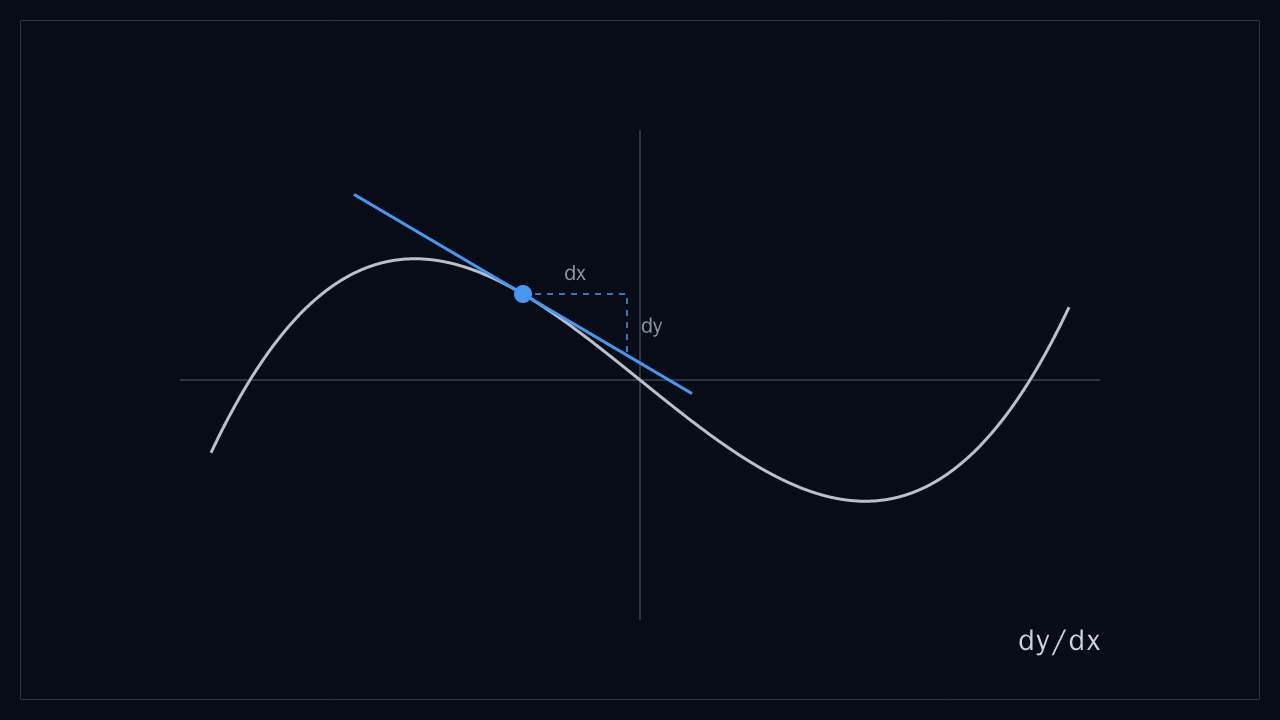
For applications: the slope of the tangent at x = x0 is f'(x0) and the normal has slope -1/f'(x0). A function is increasing where f'(x) > 0. At a stationary point, f'' < 0 means a maximum and f'' > 0 means a minimum.
Worked examples
Try each question before reading its solution. These are preparation examples, not official NET questions.
1. Find d/dx cos x°.
The trap is the degree sign. Convert first: x° = (pi/180) x radians. By the chain rule:
d/dx cos(pi x / 180) = -(pi/180) sin(pi x / 180) = -(pi/180) sin x°
Answer: -(pi/180) sin x°. The option -sin x° is there to catch you.
2. Find d/dx x^x.
Neither the power rule nor the exponential rule applies, because both base and exponent vary. Take logs:
y = x^x
ln y = x ln x
(1/y) y' = ln x + 1
y' = x^x (1 + ln x)
3. If x = t^2 and y = t^3, find d2y/dx2.
dy/dx   = 3t^2 / 2t = 3t/2
d2y/dx2 = d/dt(3t/2) / (dx/dt) = (3/2) / (2t) = 3/(4t)
With t = sqrt(x) (taking t > 0), the answer is 3/(4 sqrt(x)). The common wrong answer is 3/2, which comes from differentiating 3t/2 with respect to t and stopping there.
4. Where is f(x) = x^3 - 27x + 5 increasing?
f'(x) = 3x^2 - 27 > 0
x^2 > 9
x > 3 or x < -3,   that is |x| > 3
5. Find the 777th derivative of cos x.
The derivatives of cos x cycle with period 4: -sin x, -cos x, sin x, cos x. Since 777 = 4 x 194 + 1, the 777th derivative equals the first: -sin x.
Turn the examples into practice
Begin with untimed questions until you can explain each rule. Then mix the types, because a mixed set makes you choose the method yourself. Keep examples of missing factors and sign errors in your revision notes.
Use the derivative practice to check those corrections. Follow it with the integration guide, and keep the maths reference sheet for checking rather than copying.
Sources and scope
- Use the official subject weightings to check whether this subject belongs to your NET category.
- NUST does not publish a guaranteed chapter question count. These examples are for learning methods, not predicting a paper.
Source: HSSC textbook topics and SailToNUST practice material; NUST subject weightings reviewed October 2026
FAQ
Is further differentiation included in the NET syllabus?
Do I need to memorise inverse trigonometric derivatives for NET?
sin^-1 x and tan^-1 x are useful practice, usually inside a chain rule. Learn the three main ones and get the others from the sign pattern.