Trigonometry is easier to revise when identities have a purpose. Some simplify expressions, some connect angles, and others help you solve an equation while keeping all the valid solutions.
For NET practice, learn when to change the form of an expression. Repeated expansion is rarely a good plan if a double-angle identity or a common denominator would expose the answer.
Choose the method before calculating
Start by identifying what differs between the expression and the required form. Converting to sine and cosine can help with a fraction, while a double-angle identity can help when both x and 2x appear.
Keep angle units explicit. When solving an equation, check the stated interval and any values excluded by division. Squaring or cancelling can introduce or remove solutions.
Formula reference
These relationships need the conditions stated in the question. Check units, signs and any restrictions before substituting values.
Fundamental:
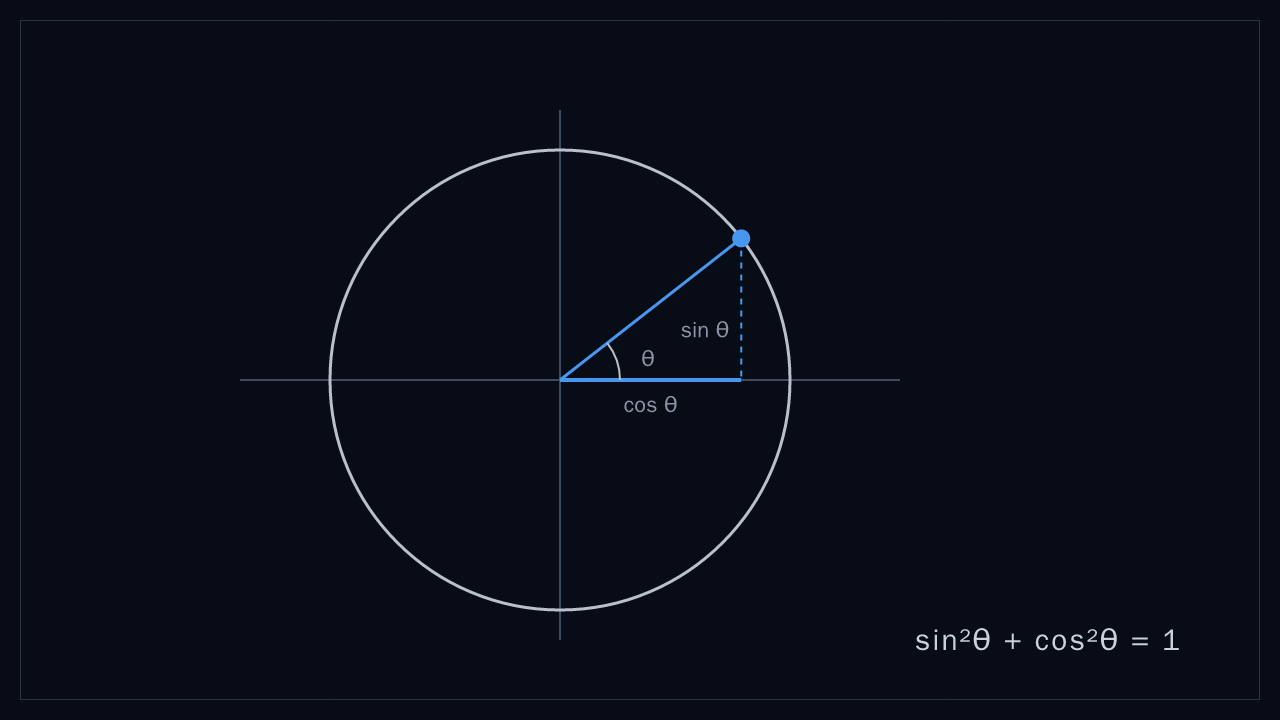
sin^2 θ + cos^2 θ = 1
1 + tan^2 θ = sec^2 θ
1 + cot^2 θ = csc^2 θ
Sum and difference:
sin(A ± B) = sin A cos B ± cos A sin B
cos(A ± B) = cos A cos B ∓ sin A sin B
tan(A ± B) = (tan A ± tan B) / (1 ∓ tan A tan B)
Double, triple and half angle:
sin 2A = 2 sin A cos A
cos 2A = cos^2 A - sin^2 A = 1 - 2 sin^2 A = 2 cos^2 A - 1
tan 2A = 2 tan A / (1 - tan^2 A)
sin 3A = 3 sin A - 4 sin^3 A
cos 3A = 4 cos^3 A - 3 cos A
sin^2(A/2) = (1 - cos A)/2
cos^2(A/2) = (1 + cos A)/2
tan(A/2)   = sin A / (1 + cos A) = (1 - cos A) / sin A
Sum to product and product to sum:
sin C + sin D = 2 sin((C + D)/2) cos((C - D)/2)
sin C - sin D = 2 cos((C + D)/2) sin((C - D)/2)
cos C + cos D = 2 cos((C + D)/2) cos((C - D)/2)
cos C - cos D = -2 sin((C + D)/2) sin((C - D)/2)

2 sin A cos B = sin(A + B) + sin(A - B)
2 cos A cos B = cos(A + B) + cos(A - B)
2 sin A sin B = cos(A - B) - cos(A + B)
Allied angles: subtract multiples of 360° until the angle lies between 0° and 360°. Then use the quadrant rule for the sign. In quadrant I all ratios are positive, in II only sin and csc, in III only tan and cot, and in IV only cos and sec.
Worked examples
Try each question before reading its solution. These are preparation examples, not official NET questions.
1. If sec θ - tan θ = x, find sec θ + tan θ.
(sec θ - tan θ)(sec θ + tan θ) = sec^2 θ - tan^2 θ = 1
sec θ + tan θ = 1/x
2. Find cos^2(45° + x) - sin^2(45° - x).
The two angles add to 90°, so sin(45° - x) = cos(45° + x). The two terms are equal and the answer is 0.
3. Write cos(3α/4) + cos(4α/3) as a product.
(C + D)/2 = (9α/12 + 16α/12)/2 = 25α/24
(C - D)/2 = (9α/12 - 16α/12)/2 = -7α/24
cos C + cos D = 2 cos(25α/24) cos(7α/24)
Cosine is even, so the minus sign on 7α/24 drops out.
4. If cos A / 3 = cos B / 4 = 1/5, with A and B between -90° and 0°, find 2 sin A + 4 sin B.
cos A = 3/5,   sin A = -4/5      (fourth quadrant, sine negative)
cos B = 4/5,   sin B = -3/5
2(-4/5) + 4(-3/5) = -8/5 - 12/5 = -4
The option +4 is waiting for anyone who ignores the quadrant.
5. What is the sign of tan 2140°?
2140° - 5(360°) = 340°
340° is in quadrant IV, where tan is negative.
Turn the examples into practice
Practise exact angles and signs alongside identity work. Verify a proposed identity with algebra; a numerical test can reject a false claim but does not prove a general one.
Use trigonometry practice, then connect it to differentiation. The formula sheet provides a reference while you build recall.
Sources and scope
- Use the official subject weightings to check whether this subject belongs to your NET category.
- NUST does not publish a guaranteed chapter question count. These examples are for learning methods, not predicting a paper.
Source: HSSC textbook topics and SailToNUST practice material; NUST subject weightings reviewed October 2026