A large power of i looks like a calculation until you notice that the answers repeat. Complex-number questions often become shorter when you recognise the structure before expanding anything.
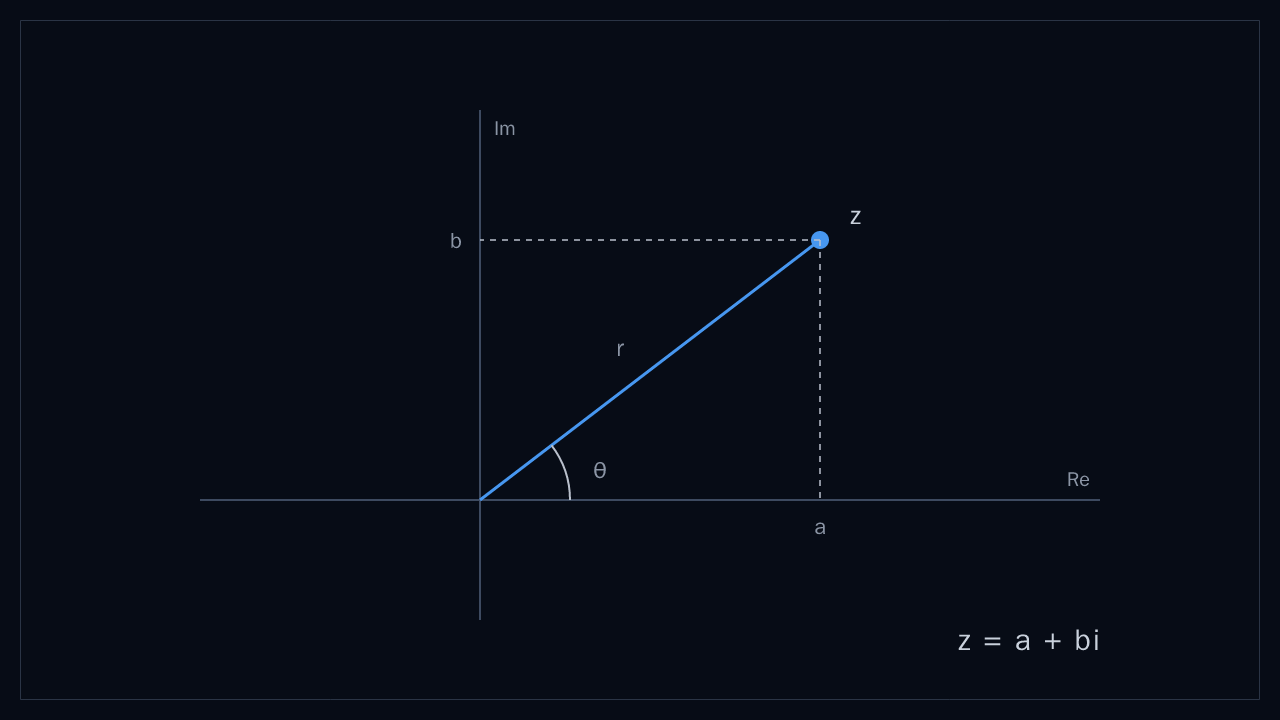
Start with powers, conjugates and modulus. Then connect Cartesian form to a point on the Argand plane, so polar form has a meaning beyond another formula to memorise.
Choose the method before calculating
Choose the form that fits the question. Cartesian form is convenient for adding numbers and finding real or imaginary parts. Polar form often helps with products and powers. A modulus of a quotient can be found from the two moduli without dividing the complex numbers first.
Always check the quadrant when finding an argument. The tangent ratio alone cannot distinguish opposite points. Also keep the imaginary part separate from the imaginary term: for a + bi, the imaginary part is b.
Formula reference
These relationships need the conditions stated in the question. Check units, signs and any restrictions before substituting values.
Powers of i repeat every 4:
i^1 = i    i^2 = -1    i^3 = -i    i^4 = 1
i^n = i^(n mod 4)       works for negative n too
For z = a + bi:
conjugate      z̄ = a - bi
modulus        |z| = sqrt(a^2 + b^2)
z z̄            = |z|^2
z + z̄          = 2a           z - z̄ = 2bi
1/z            = z̄ / |z|^2
|z1 z2|        = |z1| |z2|
|z1 / z2|      = |z1| / |z2|
Polar form and De Moivre:
z = r(cos θ + i sin θ),   r = |z|,   tan θ = b/a  (check the quadrant)
(cos θ + i sin θ)^n = cos nθ + i sin nθ
Results worth memorising because they appear inside other questions:
(1 + i)^2 = 2i          (1 - i)^2 = -2i
(1 + i)/(1 - i) = i     (1 - i)/(1 + i) = -i
square roots of i:  ±(1 + i)/sqrt(2)
Worked examples
Try each question before reading its solution. These are preparation examples, not official NET questions.
1. Find i^-27 + i^24.
-27 = 4(-7) + 1,  so i^-27 = i^1 = i
24  = 4(6),       so i^24  = 1
answer: 1 + i
2. Find |(1 + i)/(3 - i)|.
Do not divide. Take the moduli separately:
|1 + i| = sqrt(2),   |3 - i| = sqrt(10)
sqrt(2)/sqrt(10) = 1/sqrt(5) = sqrt(5)/5
3. Find the smallest positive k with ((1 + i)/(1 - i))^k = 1.
The fraction is i, from the list above. i^k = 1 first happens at k = 4.
4. Find the imaginary part of (2 + 3i)^3.
(2 + 3i)^2 = 4 + 12i - 9 = -5 + 12i
(-5 + 12i)(2 + 3i) = -10 - 15i + 24i + 36i^2 = -46 + 9i
The imaginary part is 9. Strictly, it is the real number 9, not 9i. Some options write 9i, so read the question and the options together.
5. Find the real part of (sqrt(3) + i)^3.
Expanding works but De Moivre is faster. Here r = 2 and θ = 30°:
(sqrt(3) + i)^3 = 2^3 (cos 90° + i sin 90°) = 8i
The real part is 0. Check by expansion: (sqrt(3) + i)^2 = 2 + 2 sqrt(3) i, and multiplying by sqrt(3) + i gives 2 sqrt(3) + 2i + 6i - 2 sqrt(3) = 8i.
Turn the examples into practice
Make a small mixed set containing negative powers, a quotient, a modulus and a polar-form question. The point is to choose a useful representation each time, rather than applying one long method to every question.
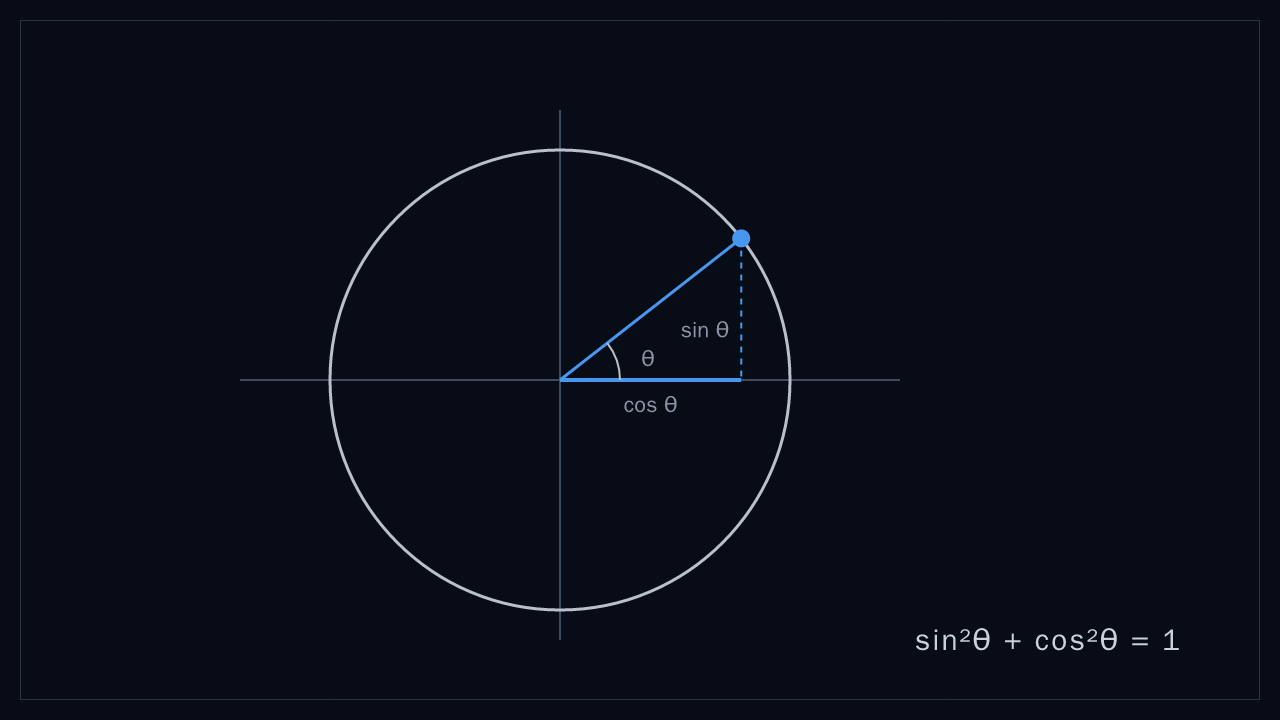
Try complex-number practice, then use trigonometry to review the angle relationships. The mathematics guide helps place this chapter in a wider plan.
Sources and scope
- Use the official subject weightings to check whether this subject belongs to your NET category.
- NUST does not publish a guaranteed chapter question count. These examples are for learning methods, not predicting a paper.
Source: HSSC textbook topics and SailToNUST practice material; NUST subject weightings reviewed October 2026
FAQ
How do I find a large power of i quickly?
What is the modulus of a complex number?
a + bi it is sqrt(a^2 + b^2), the distance of the point from the origin on the Argand plane.