A determinant can take several lines to expand, or almost no calculation if two rows are dependent. Recognising which situation you have is the useful skill in timed matrix questions.
This guide puts dimensions and properties before arithmetic. Once those are clear, inverses and systems of equations become easier to check, and you are less likely to solve a calculation the question never required.
Choose the method before calculating
Check dimensions before multiplying matrices. The order of multiplication matters, and two products that both exist need not be equal. For a determinant, inspect the rows and columns before expansion.
When finding an inverse, first establish that the determinant is non-zero. If you use row operations to simplify a determinant, track whether each operation changes its value, sign or scale.
Formula reference
These relationships need the conditions stated in the question. Check units, signs and any restrictions before substituting values.
Algebra:
(AB)^t   = B^t A^t
(AB)^-1  = B^-1 A^-1
AB ≠ BA in general
A^-1     = adj(A) / |A|      exists only if |A| ≠ 0

for A = [a  b]
        [c  d]
|A|  = ad - bc
A^-1 = (1/(ad - bc)) [ d  -b]
                     [-c   a]
Determinant properties, for an n x n matrix A:
|kA|     = k^n |A|
|A^t|    = |A|
|AB|     = |A| |B|
|A^-1|   = 1 / |A|
|adj A|  = |A|^(n-1)

|A| = 0 if two rows (or columns) are equal or proportional
|A| = 0 if a row (or column) is all zeros
swapping two rows changes the sign of |A|
adding a multiple of one row to another leaves |A| unchanged

cofactor  A_ij = (-1)^(i+j) M_ij
Special matrices:
symmetric        A^t = A
skew-symmetric   A^t = -A     (odd order means |A| = 0)
orthogonal       A A^t = I    (so |A| = ±1)
singular         |A| = 0
Cramer's rule for a system AX = B with |A| ≠ 0: replace the column of the unknown with B, take that determinant, divide by |A|.
For any 2x2 matrix, A^2 - (trace A) A + |A| I = 0. This is the Cayley-Hamilton result, and it solves a whole class of NET questions in one line.
Worked examples
Try each question before reading its solution. These are preparation examples, not official NET questions.
1. A is a 4x4 matrix with |A| = 5. Find |2A|.
|2A| = 2^4 x 5 = 80
The wrong option is 10, from forgetting the power.
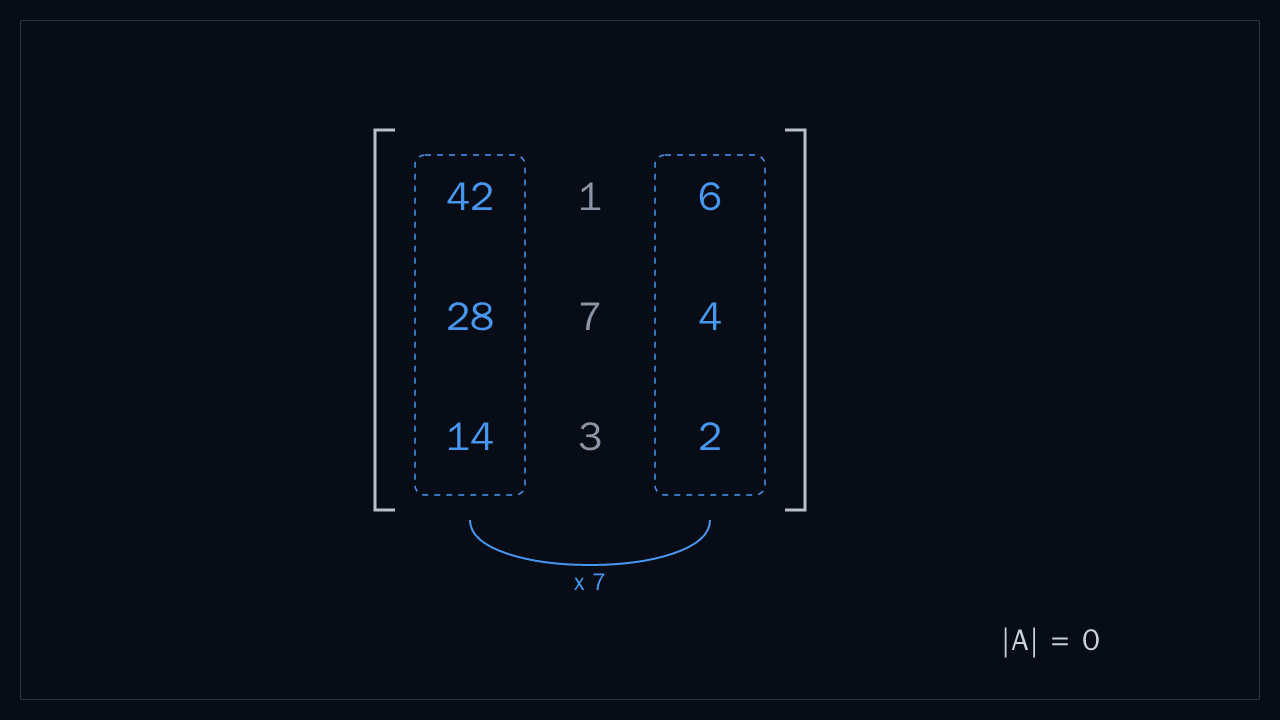
2. Evaluate the determinant with rows (42, 1, 6), (28, 7, 4), (14, 3, 2).
Look before you expand. Column 1 is 42, 28, 14. Column 3 is 6, 4, 2. Column 1 is 7 times column 3, so the determinant is 0.
3. If A has rows (1, 0) and (-1, 7), and A^2 = 8A + kI, find k.
Use Cayley-Hamilton. The trace is 1 + 7 = 8 and |A| = 7 - 0 = 7:
A^2 - 8A + 7I = 0
A^2 = 8A - 7I,   so k = -7
Check by multiplying: A^2 has rows (1, 0) and (-8, 49), and 8A - 7I has the same rows.
4. Evaluate the determinant with rows (1, -3, -6), (0, 4, -3i), (0, -3i, 4).
Expand along the first column, which has two zeros:
1 x [4(4) - (-3i)(-3i)] = 16 - 9i^2 = 16 + 9 = 25
5. Solve 2x + y = 5 and x - y = 1 by Cramer's rule.
|A|  = (2)(-1) - (1)(1) = -3
|Ax| = (5)(-1) - (1)(1) = -6      x = -6 / -3 = 2
|Ay| = (2)(1)  - (5)(1) = -3      y = -3 / -3 = 1
Check: 2(2) + 1 = 5 and 2 - 1 = 1.
Turn the examples into practice
Mix property questions with small calculations. After finding a 2 by 2 inverse, multiply it by the original matrix as a check. For a system of equations, substitute the proposed values back into the equations.
Try matrix practice. Review complex numbers if entries contain i, and use the formula sheet for a compact revision reference.
Sources and scope
- Use the official subject weightings to check whether this subject belongs to your NET category.
- NUST does not publish a guaranteed chapter question count. These examples are for learning methods, not predicting a paper.
Source: HSSC textbook topics and SailToNUST practice material; NUST subject weightings reviewed October 2026
FAQ
What is the fastest way to find the inverse of a 2x2 matrix?
What is the determinant of a skew-symmetric matrix?
Is Cramer's rule in the NET syllabus?
What is |kA| for a 3x3 matrix?
k^3 |A|. For an n x n matrix the power is n.