Counting questions can produce a plausible answer from the wrong formula. The deciding question comes before nPr or nCr: if the selected people or objects swap places, have you created a different outcome?
If order changes the outcome, arrangements matter. If the same group remains the same selection, it usually does not. The restrictions in the wording then determine what you can count.
Choose the method before calculating
Describe one valid outcome before calculating. Identify whether repetition is allowed, whether objects are distinct and whether any positions are restricted. A list of three outcomes for a small version of the problem can reveal an incorrect assumption.
For conditions such as "at least one", consider counting the complement. For several cases, make sure they do not overlap before adding their counts.
Formula reference
These relationships need the conditions stated in the question. Check units, signs and any restrictions before substituting values.
n!   = n(n - 1)(n - 2) ... 1,        0! = 1
nPr  = n! / (n - r)!
nCr  = n! / [r! (n - r)!]
nCr  = nC(n - r)
nCr + nC(r - 1) = (n + 1)Cr
Arrangement rules:
n items with p alike, q alike, ...     n! / (p! q! ...)
n items in a circle                    (n - 1)!
necklace or garland (can flip)         (n - 1)! / 2
two items always together              treat as one block: (n - 1)! x 2!
two items never together               total - together
Geometry counts:
diagonals of an n-sided polygon        nC2 - n = n(n - 3)/2
lines from n points, none collinear    nC2
lines from n points, m collinear       nC2 - mC2 + 1
triangles from n points, m collinear   nC3 - mC3
rectangles on an 8 x 8 chessboard      9C2 x 9C2
Selections:
at least one from n distinct items     2^n - 1
probability of an event                favourable outcomes / total outcomes
Worked examples
Try each question before reading its solution. These are preparation examples, not official NET questions.
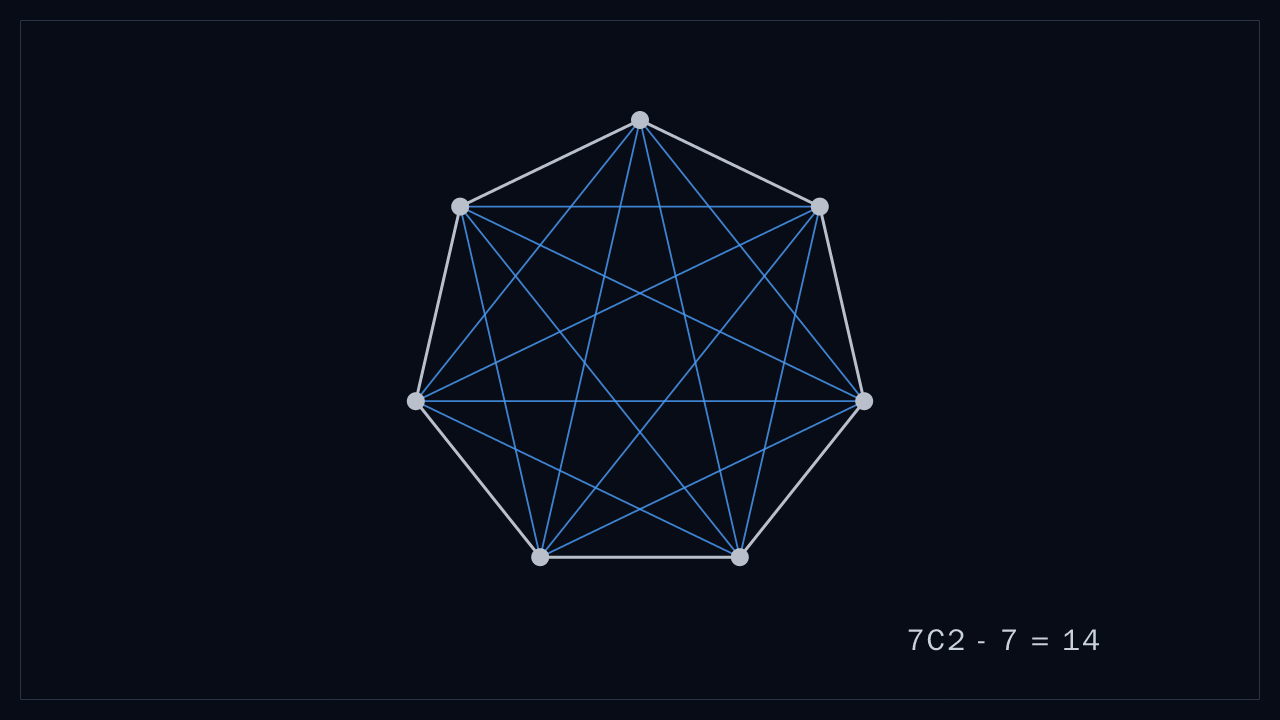
1. How many diagonals does a 7-sided polygon have?
7(7 - 3)/2 = 14
2. 13 points lie in a plane. No three are collinear except 5 of them. How many lines can be drawn?
Count as if none were collinear, remove the lines among the 5, then add back the one line they all lie on:
13C2 - 5C2 + 1 = 78 - 10 + 1 = 69
3. How many 5-digit numbers can be made from 1, 2, 3, 4, 5 (no repeats) with 1 and 5 never next to each other?
total arrangements          5!        = 120
1 and 5 together            4! x 2!   = 48
never together              120 - 48  = 72
4. How many rectangles are there on a chessboard?
A rectangle is fixed by choosing 2 of the 9 horizontal lines and 2 of the 9 vertical lines:
9C2 x 9C2 = 36 x 36 = 1296
5. A team of 11 is chosen from 13 players: 4 bowlers, 2 wicketkeepers and 7 others. The team must have exactly one wicketkeeper and at least 3 bowlers. How many ways?
One keeper takes one place, leaving 10 places for bowlers and others. Split by the number of bowlers:
3 bowlers + 7 others:  4C3 x 7C7 = 4 x 1 = 4
4 bowlers + 6 others:  4C4 x 7C6 = 1 x 7 = 7
choose the keeper:     2C1 = 2
total = (4 + 7) x 2 = 22
Turn the examples into practice
During review, write why order matters or does not matter for each question. A correct numerical answer without that explanation may hide a guess. Use small examples to check difficult restrictions.
Try counting practice, then review sequences and series for related algebra. The mathematics guide helps balance this with the rest of the syllabus.
Sources and scope
- Use the official subject weightings to check whether this subject belongs to your NET category.
- NUST does not publish a guaranteed chapter question count. These examples are for learning methods, not predicting a paper.
Source: HSSC textbook topics and SailToNUST practice material; NUST subject weightings reviewed October 2026
FAQ
How do I know whether to use permutation or combination?
Is probability included with permutations and combinations in NET?
What is the formula for the number of diagonals of a polygon?
n(n - 3)/2. A hexagon has 9 and a decagon has 35.Why is 0! equal to 1?
nCn = n!/(n! 0!) equal to 1.