Before finding a distant term, check how the sequence changes. A constant difference suggests an arithmetic sequence; a constant ratio suggests a geometric one. Confusing those two can make every later step look correct while the answer is wrong.
This guide connects the pattern to the term and sum formulas. It also separates a finite sum from an infinite one, where a convergence condition changes what you are allowed to do.
Choose the method before calculating
Write a, d or r and the requested n before substitution. If a question gives terms indirectly, form equations from those terms rather than guessing a pattern from the answer options.
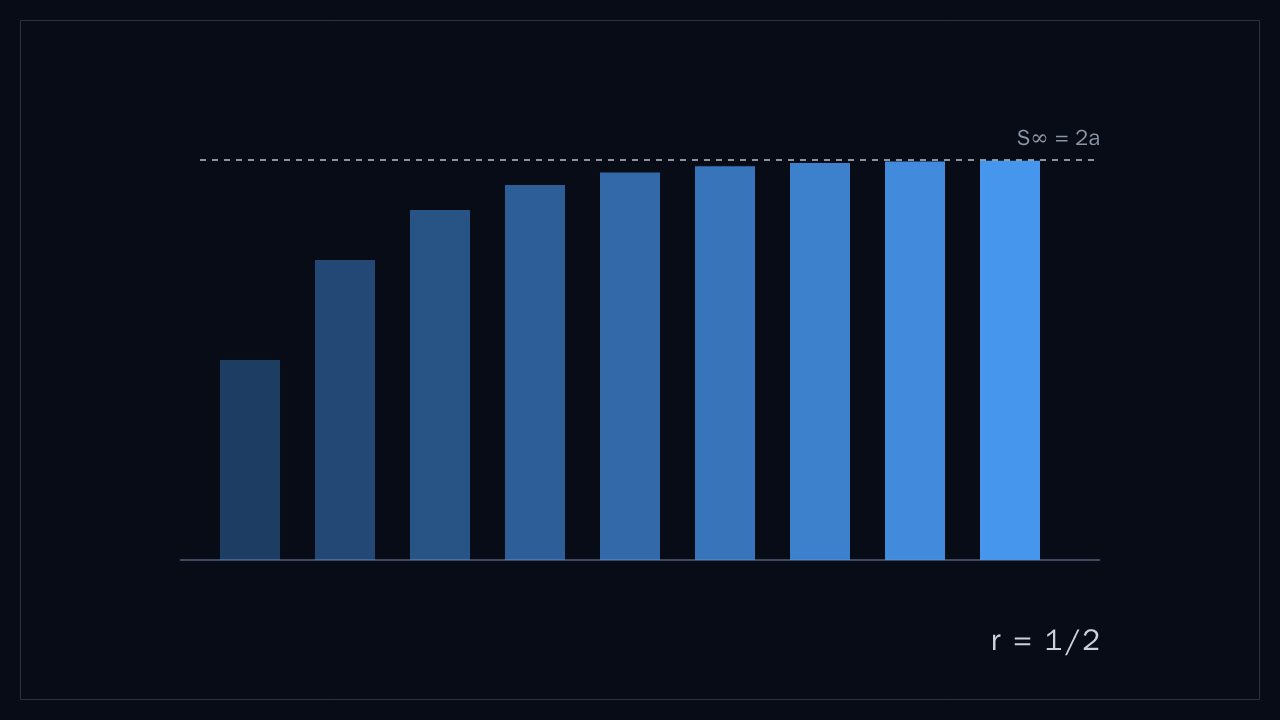
For an infinite geometric series, check the absolute value of the common ratio before using the sum formula. A decreasing-looking first pair of terms is not a substitute for that condition.
Formula reference
These relationships need the conditions stated in the question. Check units, signs and any restrictions before substituting values.
Arithmetic progression (AP), first term a, common difference d:
a_n = a + (n - 1) d
S_n = (n/2) [2a + (n - 1) d] = (n/2)(a + l)      l = last term
Geometric progression (GP), first term a, common ratio r:
a_n = a r^(n - 1)
S_n = a (1 - r^n) / (1 - r)          r ≠ 1
S_inf = a / (1 - r)                  only if |r| is less than 1
Harmonic progression (HP): a sequence whose reciprocals form an AP. There is no sum formula. Convert to the AP, work there, and convert back.
Means between a and b:
AM = (a + b)/2
GM = ±sqrt(ab)
HM = 2ab/(a + b)
GM^2 = AM x HM
for positive a ≠ b:   AM > GM > HM
Standard sums:
1 + 2 + ... + n         = n(n + 1)/2
1^2 + 2^2 + ... + n^2   = n(n + 1)(2n + 1)/6
1^3 + 2^3 + ... + n^3   = [n(n + 1)/2]^2
Recurring decimals: two repeating digits go over 99, three over 999. So 0.(53) repeating is 53/99.
Worked examples
Try each question before reading its solution. These are preparation examples, not official NET questions.
1. Find the sum to infinity of (-3/7)^(2n) from n = 1.
An even power kills the minus sign: (-3/7)^(2n) = (9/49)^n. This is a GP with first term 9/49 and ratio 9/49:
S_inf = (9/49) / (1 - 9/49) = (9/49) / (40/49) = 9/40
2. If 2 + 5 + 8 + 11 + ... + a_n = 60100, find n.
AP with a = 2 and d = 3:
(n/2)[4 + 3(n - 1)] = 60100
n(3n + 1) = 120200
Try the options rather than solving the quadratic. n = 200 gives 200 x 601 = 120200. Answer: 200.
3. Write 1.(53), with 53 repeating, as a fraction. Find numerator minus denominator.
1.(53) = 1 + 53/99 = 152/99
152 - 99 = 53
4. A clock strikes twice at 1 o'clock, four times at 2, and so on. How many strikes in 12 hours?
The strikes are 2, 4, 6, ..., 24. That is 2(1 + 2 + ... + 12) = 2 x 78 = 156.
5. In an infinite GP, each term equals twice the sum of all the terms after it. Find r.
Take the first term. The terms after it sum to S - a = a/(1 - r) - a = ar/(1 - r):
a = 2 ar/(1 - r)
1 - r = 2r
r = 1/3
Turn the examples into practice
Practise questions that ask for a term, a sum and an unknown parameter in the same set. Check whether your proposed sequence reproduces the terms given in the question.
Use series practice, keep the formula sheet for checking, and follow the maths guide to avoid revising only the chapters you enjoy.
Sources and scope
- Use the official subject weightings to check whether this subject belongs to your NET category.
- NUST does not publish a guaranteed chapter question count. These examples are for learning methods, not predicting a paper.
Source: HSSC textbook topics and SailToNUST practice material; NUST subject weightings reviewed October 2026
FAQ
What is the difference between AP, GP and HP?
When does an infinite geometric series have a sum?
a/(1 - r).How do I convert a recurring decimal to a fraction quickly?
0.(7) is 7/9 and 0.(53) is 53/99. Add any whole-number part afterwards.