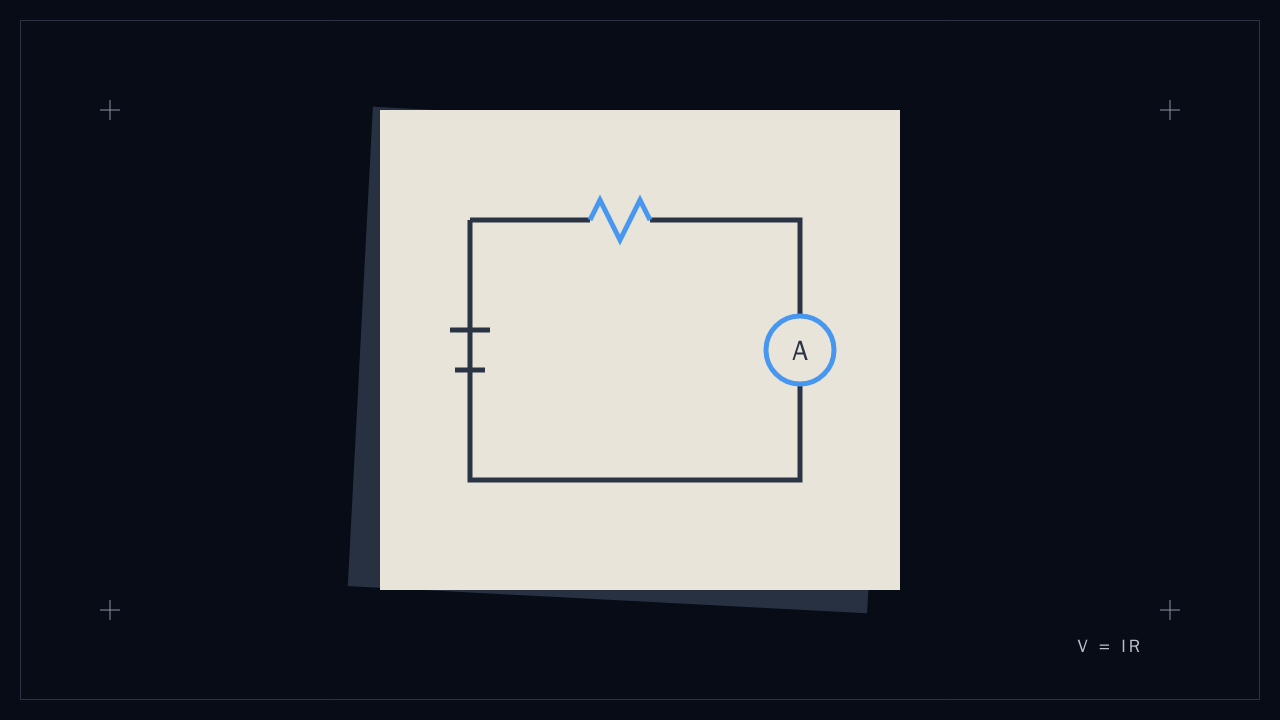
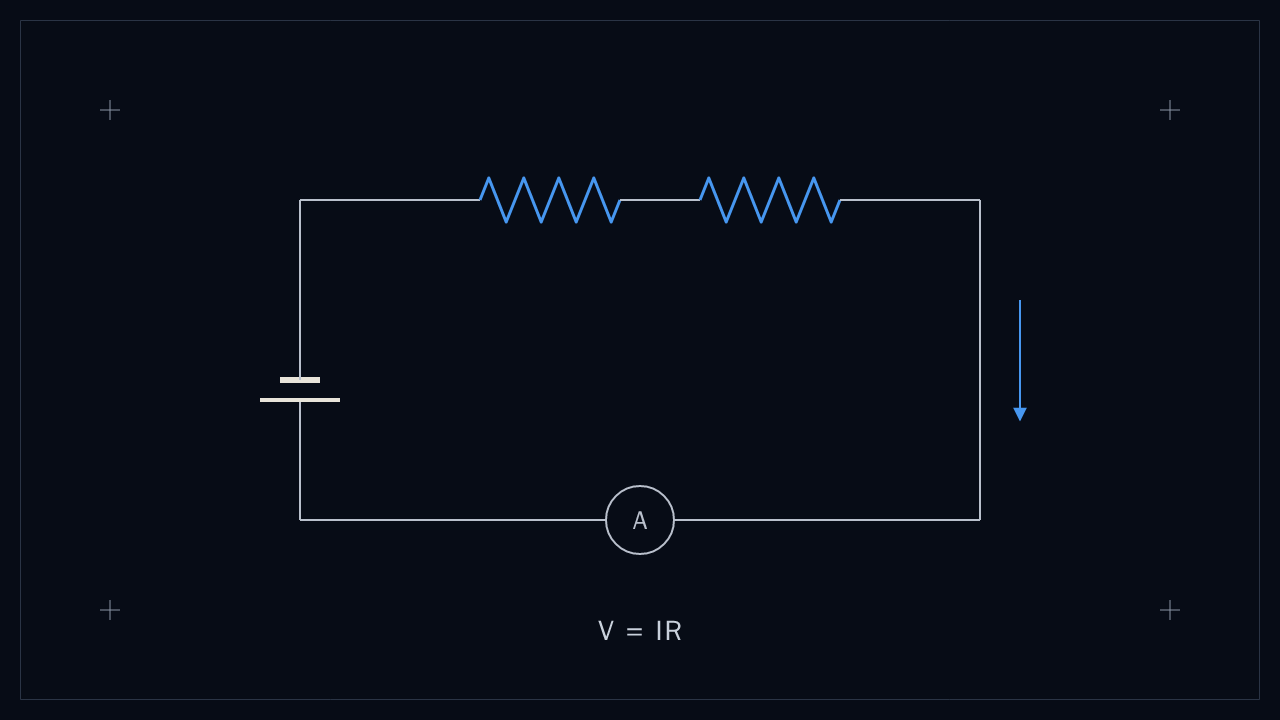
Circuit questions become manageable when you identify which components share a current and which share a potential difference. Applying a series formula to a parallel branch is a more common problem than difficult arithmetic.
Begin by reading the connections. A tidy redraw can make the circuit clearer and show whether Ohm's law, an equivalent resistance or a loop equation is the useful next step.
Choose the method before calculating
Mark junctions and label the quantities you know. Components in series share current; components connected across the same two nodes share voltage. The visual position of a resistor on the page does not decide the connection.
Separate emf from terminal voltage when internal resistance appears. For power questions, choose a formula using quantities that apply to the same component.
Formula reference
These relationships need the conditions stated in the question. Check units, signs and any restrictions before substituting values.
Current                I = Q/t                  A = C s⁻¹
Drift                  I = nAvq
Ohm's law              V = IR                   Ω = V A⁻¹
Resistance of a wire   R = ρL/A                 ρ in Ω m
Temperature            R_T = R₀(1 + αΔT)        α in K⁻¹
Conductance            G = 1/R                  siemens (S)

Series                 R = R₁ + R₂ + ...        same current
Parallel               1/R = 1/R₁ + 1/R₂ + ...  same voltage
Two in parallel        R = R₁R₂ / (R₁ + R₂)
n equal resistors R    series nR, parallel R/n

Power                  P = VI = I²R = V²/R      W
Energy                 E = Pt;  1 kWh = 3.6 × 10⁶ J

emf and internal resistance
I = ε / (R + r)
Terminal voltage       V = ε − Ir
Maximum power to load  when R = r

Wheatstone bridge balance   P/Q = R/S
Worked examples
Try each question before reading its solution. These are preparation examples, not official NET questions.
1. Two wires in parallel. Wires P and Q are the same material and length. P has diameter 2 mm and Q has diameter 1 mm. Both connect in parallel across the same supply. What is the ratio of current in P to current in Q?
(a) 1/4 (b) 4 (c) 2 (d) 1/2
R = ρL/A and A ∝ d²
d_P = 2 d_Q   so  A_P = 4 A_Q   so  R_P = R_Q / 4
Same V across both:  I ∝ 1/R
I_P / I_Q = 4
Answer (b). People who scale with d instead of d² pick (c).
2. Stretching a wire. A wire of resistance R is stretched to twice its length. Its volume stays the same. What is the new resistance?
(a) R/2 (b) 2R (c) 4R (d) R
Volume = AL constant
L → 2L  means  A → A/2
R = ρL/A → ρ(2L)/(A/2) = 4R
Answer (c). The general rule: stretch by a factor n and resistance goes up n². Picking (b) means you forgot the area shrinks.
3. Bulb on half voltage. A bulb is rated 100 W, 220 V. What power does it draw on a 110 V supply? Assume its resistance does not change.
(a) 50 W (b) 25 W (c) 100 W (d) 200 W
R = V²/P = 220² / 100 = 484 Ω
P = 110² / 484 = 25 W
Answer (b). Halve the voltage and power drops to a quarter, because P = V²/R with R fixed.
4. Battery with internal resistance. A cell of emf 12 V and internal resistance 0.5 Ω drives current through a 5.5 Ω resistor. What is the terminal voltage?
(a) 12 V (b) 11 V (c) 10 V (d) 6 V
I = ε / (R + r) = 12 / 6 = 2 A
V = ε − Ir = 12 − 2 × 0.5 = 11 V
Answer (b). A voltmeter across the cell reads 11 V, not 12 V, while current flows. It only reads the full emf on open circuit.
5. Smallest resistance from two resistors. What is the smallest resistance you can make from a 6 Ω and a 12 Ω resistor?
(a) 2 Ω (b) 4 Ω (c) 6 Ω (d) 18 Ω
Parallel: (6 × 12) / (6 + 12) = 72 / 18 = 4 Ω
Answer (b). A parallel combination is always smaller than the smallest single resistor in it. If you got an answer above 6 Ω for a parallel pair, check your arithmetic.
Turn the examples into practice
Use electricity practice and explain each series or parallel reduction before calculating. Check whether the final current and power are physically sensible.
The electrostatics guide helps with potential and charge, while the physics formula sheet keeps the circuit relationships together.
Sources and scope
- Use the official subject weightings to check whether this subject belongs to your NET category.
- NUST does not publish a guaranteed chapter question count. These examples are for learning methods, not predicting a paper.
Source: HSSC textbook topics and SailToNUST practice material; NUST subject weightings reviewed October 2026