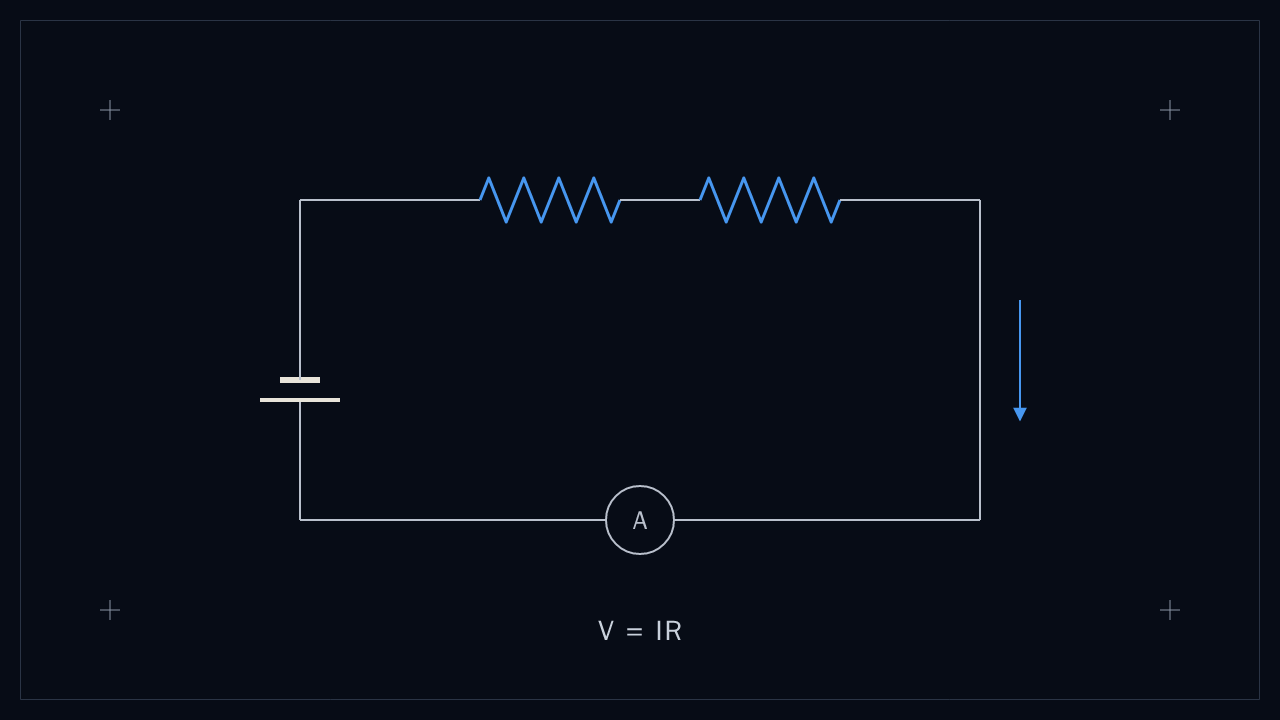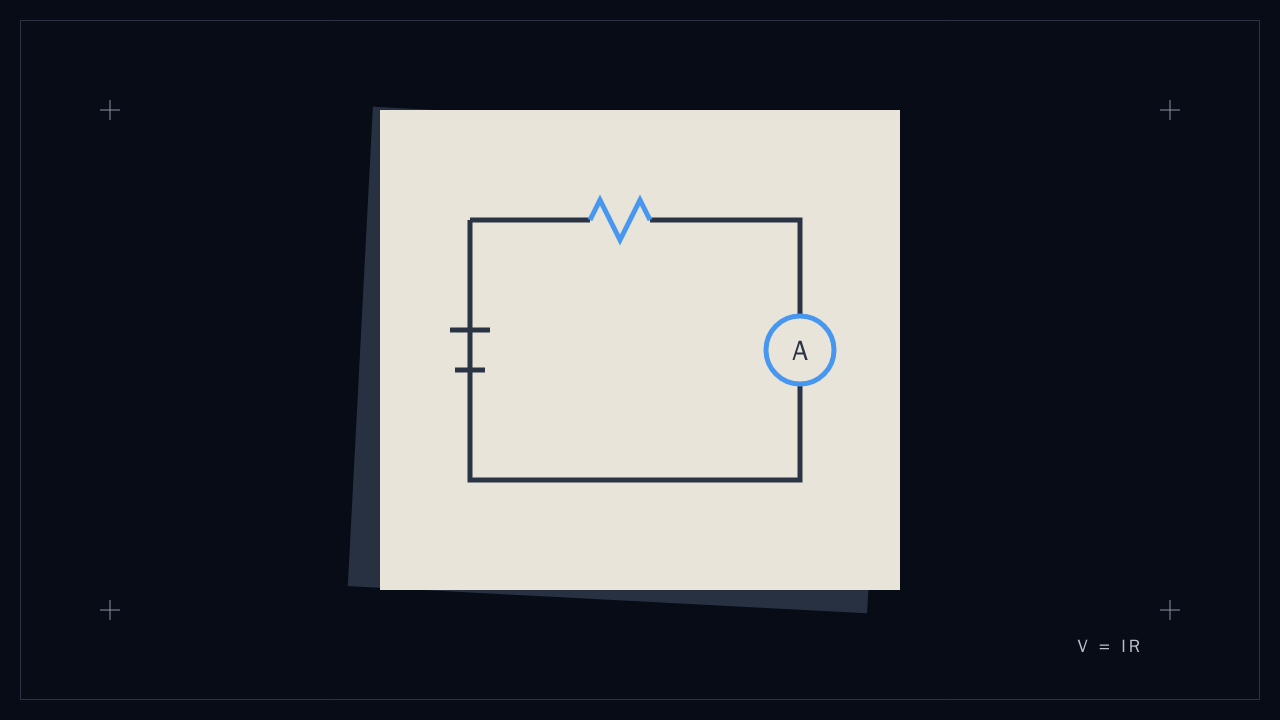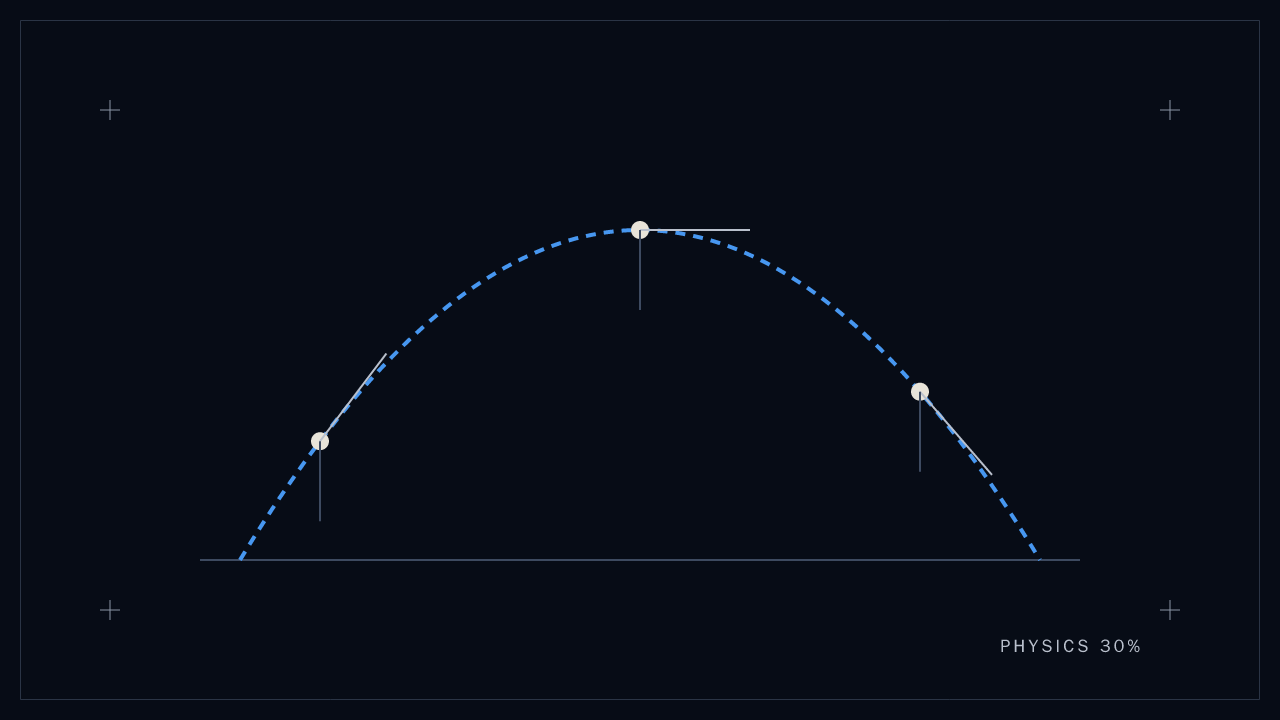
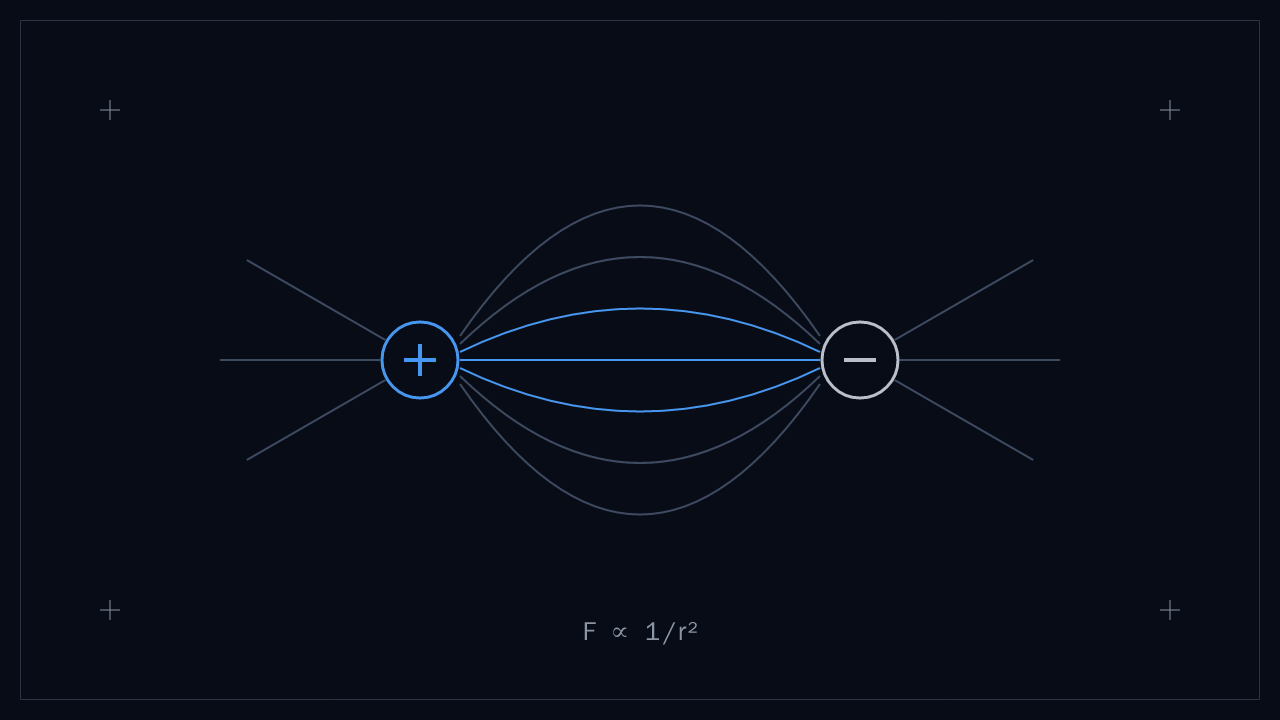
Electric field and electric potential describe the same charge arrangement in different ways. Field has a direction; potential is a scalar. Keeping that distinction clear prevents many errors when several charges appear in one question.
This guide starts with what you add and what you are finding. Once that is clear, inverse-square relationships and capacitor calculations become easier to organise.
Choose the method before calculating
Sketch the charge positions and the point of interest. Add electric fields as vectors and potentials as scalars. A zero potential does not automatically mean a zero field.
For capacitors, identify whether voltage or charge stays fixed when the arrangement changes. A capacitor connected to a battery follows a different condition from an isolated charged capacitor.
Formula reference
These relationships need the conditions stated in the question. Check units, signs and any restrictions before substituting values.
Coulomb's law          F = k q₁q₂ / r²
                       k = 1/(4πε₀) = 9 × 10⁹ N m² C⁻²
                       ε₀ = 8.85 × 10⁻¹² C² N⁻¹ m⁻²
In a dielectric        F = k q₁q₂ / (εᵣ r²)

Electric field         E = F/q = kq/r²          N C⁻¹ (same as V m⁻¹)
Between parallel plates E = V/d
Potential of a point charge  V = kq/r            V = J C⁻¹
Work moving a charge   W = qΔV
Electron-volt          1 eV = 1.6 × 10⁻¹⁹ J

Electric flux          Φ = EA cosθ              N m² C⁻¹
Gauss's law            Φ = Q_enclosed / ε₀

Capacitance            C = Q/V                  F = C V⁻¹
Parallel plates        C = ε₀εᵣA / d
Energy stored          U = ½CV² = ½QV = Q²/2C
Series                 1/C = 1/C₁ + 1/C₂ + ...
Parallel               C = C₁ + C₂ + ...
RC time constant       τ = RC                   s
Worked examples
Try each question before reading its solution. These are preparation examples, not official NET questions.
1. Two charges in air. Charges of 3 μC and 4 μC sit 30 cm apart in air. What is the force between them?
(a) 0.12 N (b) 1.2 N (c) 12 N (d) 0.4 N
F = 9 × 10⁹ × (3 × 10⁻⁶)(4 × 10⁻⁶) / (0.3)²
  = 9 × 10⁹ × 12 × 10⁻¹² / 0.09
  = 0.108 / 0.09 = 1.2 N
Answer (b). Put the same pair in oil with εᵣ = 4 and the force drops to 0.3 N.
2. Touch and separate. Two identical small conducting spheres carry +10 μC and −20 μC and attract with force F₁ at distance R. They are touched together and returned to distance R, where the force is F₂. What is F₁ : F₂?
(a) 1 : 8 (b) −8 : 1 (c) 1 : 2 (d) −2 : 1
After contact, total charge −10 μC splits equally: −5 μC each
F₁ ∝ (+10)(−20) = −200   (attraction)
F₂ ∝ (−5)(−5)   = +25    (repulsion)
F₁ : F₂ = −200 : 25 = −8 : 1
Answer (b). The minus sign only records that one force attracts and the other repels. Identical spheres share charge equally. Spheres of different radius do not, so look for the word "identical" before you split evenly.
3. Capacitors in series. A 3 μF and a 6 μF capacitor are joined in series across 12 V. What is the voltage across the 3 μF capacitor?
(a) 4 V (b) 6 V (c) 8 V (d) 12 V
C = (3 × 6)/(3 + 6) = 2 μF
Q = CV = 2 × 12 = 24 μC   (same on both in series)
V₃ = Q/C = 24/3 = 8 V,   V₆ = 24/6 = 4 V
Answer (c). In series the smaller capacitor takes the larger share of the voltage. That is the reverse of resistors in series, and it is why (a) is a tempting wrong answer.
4. Energy and time constant. A 2 μF capacitor charges to 100 V through a 1 MΩ resistor. How much energy does it store, and what is the time constant?
U = ½CV² = ½ × 2 × 10⁻⁶ × 100² = 0.01 J
τ = RC = 10⁶ × 2 × 10⁻⁶ = 2 s
After one time constant the capacitor holds 63% of its final charge. It never reaches 100% in theory, though it gets past 99% after about 5τ.
5. Electron through a potential difference. An electron starts from rest and accelerates through 1000 V. What is its final speed? (mₑ = 9.11 × 10⁻³¹ kg)
(a) 1.9 × 10⁵ m/s (b) 1.9 × 10⁷ m/s (c) 3.5 × 10¹⁴ m/s (d) 6 × 10⁸ m/s
K = eV = 1.6 × 10⁻¹⁹ × 1000 = 1.6 × 10⁻¹⁶ J  (= 1000 eV)
v = √(2K/m) = √(3.2 × 10⁻¹⁶ / 9.11 × 10⁻³¹) = √(3.51 × 10¹⁴)
v ≈ 1.87 × 10⁷ m/s
Answer (b). Option (c) is v² with the square root forgotten. Option (d) is faster than light, which should rule it out on sight.
Turn the examples into practice
Practise one arrangement using both field and potential so you can see why their answers differ. Use electrostatics practice and check signs before substituting values.
Continue with current electricity, and use the physics guide to connect electricity with the rest of your revision.
Sources and scope
- Use the official subject weightings to check whether this subject belongs to your NET category.
- NUST does not publish a guaranteed chapter question count. These examples are for learning methods, not predicting a paper.
Source: HSSC textbook topics and SailToNUST practice material; NUST subject weightings reviewed October 2026