NUST closing merit describes the last selected candidate for a particular programme and selection stage, expressed as a position or aggregate depending on the source. A published closing position does not tell you the NET score needed, because your academic marks and that year's applicant pool also matter.
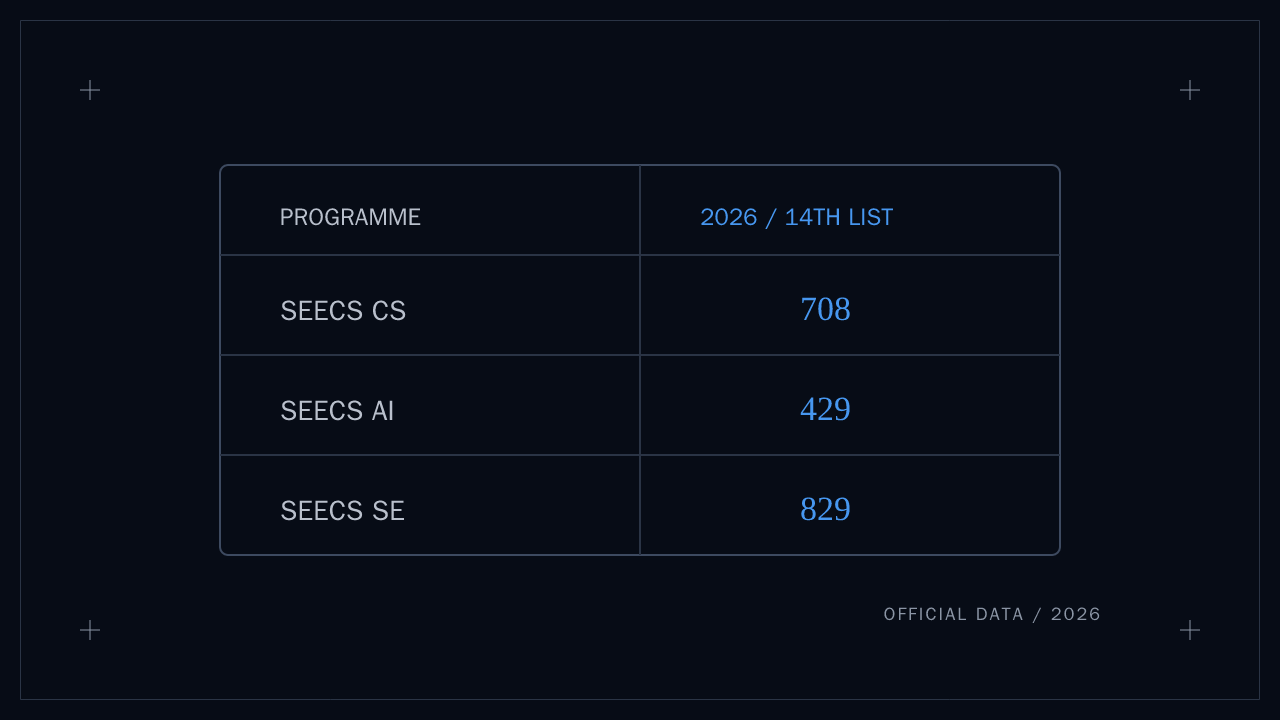
The NUST Admissions Directorate, 14th merit selection list, UG 2026 gives SEECS Computer Science 708, Artificial Intelligence 429 and Software Engineering 829. Read the full NUST closing merit 2026 tables for each programme and institute. These are 14th-list ranks, not closing aggregates.
What the sources establish
- NUST labels its public historical table as closing merit positions.
- The UG 2026 record gives programme-specific 14th-list closing positions.
- A standard NET aggregate uses NET 75%, HSSC 15% and SSC 10%.
- Your portal selection status and offer instructions govern your next admission step.
Source: NUST Admissions Directorate, 14th merit selection list, UG 2026; NUST merit criteria and selection process; checked November 2026
Check the label before using the number
A rank and a percentage answer different questions. A position tells you where an applicant sits within a merit list. An aggregate combines NET and academic results. A screenshot that says only "closing merit 80" leaves the measure unclear.
Before using a figure, record its programme, school, year, admission route and list stage. An early selection figure need not equal the final position. A Computing rank should not be compared with a Business rank as though both came from one applicant list.
Open the official closing page and keep the source with your notes. If a private site supplies an aggregate estimate, keep its estimate label. Do not rewrite it as NUST's own percentage.
Use the 2026 positions with their institute labels
| Programme | Institute | 2026 14th-list closing position |
|---|---|---|
| BS Computer Science | SEECS | 708 |
| BS Computer Science | PNEC | 3025 |
| BS Computer Science | NBC | 8419 |
| BS Artificial Intelligence | SEECS | 429 |
| BE Software Engineering | SEECS | 829 |
| BBA | NBS | 722 |
| BS Accounting and Finance | NBS | 467 |
Source: NUST Admissions Directorate, 14th merit selection list, UG 2026. The complete 2026 record includes the other programmes. NUST has since taken the table off its public closing-merit page.
SEECS CS and NBC CS have the same degree name, but applicants rank different campuses and living arrangements. Preferences and available seats affect selection movement. A larger closing position does not measure teaching quality, and it cannot reveal how far a closing aggregate fell.
Compare the same programme, institute, merit pool and list stage before drawing a trend across years. The 14th-list record does not supply first-list positions or a verified 2025 comparison. Rank the choices you would accept in the order you want them, then use historical positions as context.
Convert an aggregate target, not a rank
You can calculate a NET target without claiming that it predicts admission. Use the merit formula guide:
Aggregate = NET / 200 * 75 + HSSC% * 0.15 + SSC% * 0.10
NET needed = (target - HSSC% * 0.15 - SSC% * 0.10) / 0.375
For HSSC 80% and SSC 90%, your academic marks contribute 21 aggregate points. An illustrative 75% target requires 54 / 0.375 = 144 NET marks. An 80% target requires 157.33, which rounds up to 158. Neither target is an official programme closing aggregate.
Each extra NET mark adds 0.375 aggregate points. Use the worked NET marks table to compare profiles, then replace its examples with your own results. Use the accepted academic result and correct total rather than mixing Part-I marks with a full-FSc denominator.
Use your selection status when offers arrive
NUST's selection process directs applicants to its UG portal to check their merit position and selection status. Follow your own offer letter's fee deadline. Historical closing data cannot confirm an offer or extend its deadline.
Read how merit lists work before changing preferences. Keep programmes you would accept in your plan. If you missed selection, the what next guide covers decisions about another attempt and other options.
Turn the target into practice
Check your paper in the syllabus before choosing preparation material. For Engineering and Computing applicants, a timed Engineering full paper gives you a score to compare with your calculated target. Review the mistakes before taking the next paper.
Write down whether you lost marks through a missing concept, a calculation error or a rushed answer. Use chapter practice for the topics behind those errors. Rehearse the controls in the simulator if saving and reviewing answers interrupts your work.