A target of 170 can help organise your NET work, but it can also distract you if every practice score becomes a verdict. The useful part of the target is what it asks you to improve: accuracy, coverage and decisions under time pressure.
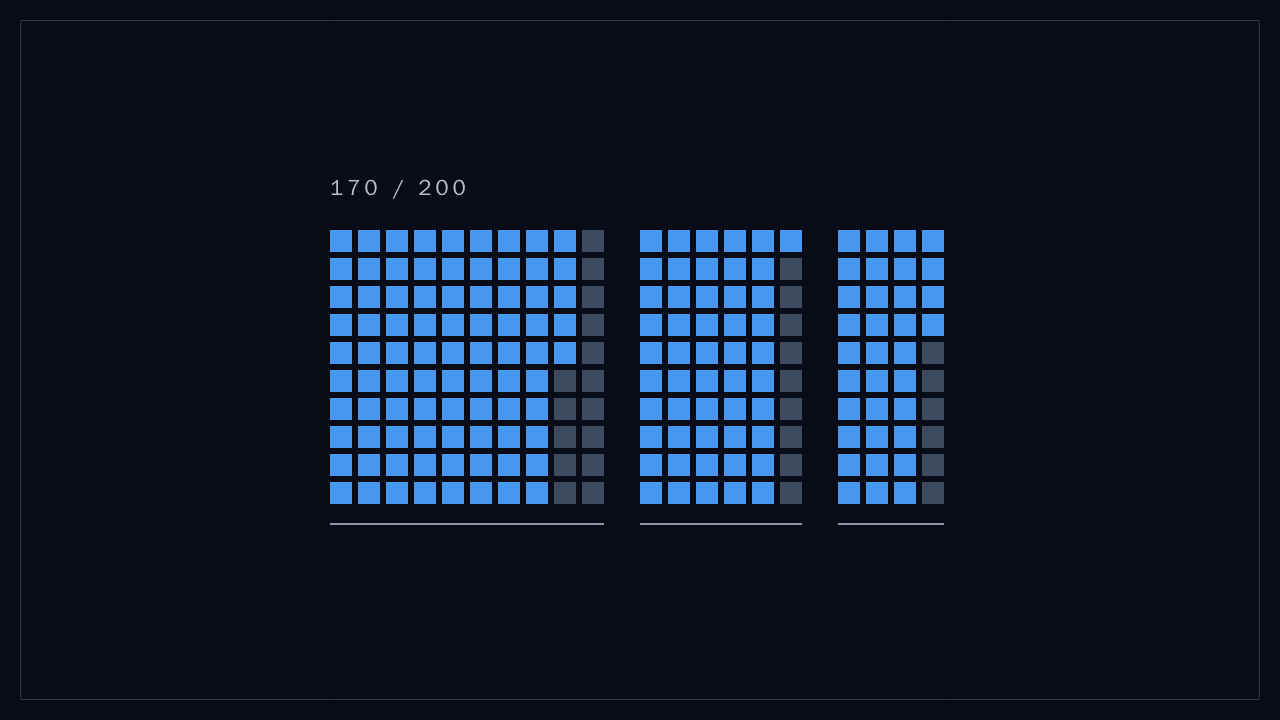
170 out of 200 is 85%. There is no single subject split that produces it. Your plan should build on your strengths while repairing the errors you repeat, rather than copying someone else's ideal scorecard.
Turn the target into error categories
Separate questions you could not solve from questions you could solve but lost through arithmetic, wording or time. Those groups need different work. A new lesson helps with a missing concept; it may not fix a repeated sign error.
Track guesses as well as wrong answers. A correct guess improves one score but does not demonstrate a method you can reuse. Review it before deciding that the topic is secure.
Use several reviewed practice sittings to judge progress. Papers differ in difficulty, so a change in one score does not measure your ability precisely.
Put the target into the merit formula
NET carries 75% of the aggregate. A 170 contributes:
170 / 200 * 75 = 63.75 aggregate points
each NET mark  = 75 / 200 = 0.375 aggregate points
Add your school marks. A student with 990 of 1100 in matric and 473 of 550 in FSc part 1 would get:
SSC:   990 / 1100 * 10 = 9.00
HSSC:  473 / 550  * 15 = 12.90
NET:   170 / 200  * 75 = 63.75
Aggregate              = 85.65
Whether that is enough depends on the programme and the year. NUST publishes the previous session's closing merit for guidance. Run your own numbers in the aggregate calculator, and see what NET score you need for how to read closing merit.
See different routes to the same total
Every question is worth one mark, whichever section it is in. So 170 can come from many splits. Three of them:
| Split | Mathematics (100) | Physics (60) | English (40) | Total |
|---|---|---|---|---|
| Even | 85 (85%) | 51 (85%) | 34 (85%) | 170 |
| Strong English | 82 (82%) | 50 (83%) | 38 (95%) | 170 |
| Strong Mathematics | 90 (90%) | 48 (80%) | 32 (80%) | 170 |
The second row is the one most students should aim for. Getting 38 of 40 in English is easier than getting 90 of 100 in Mathematics, because English questions are short and the gap between knowing a word and not knowing it is fast to close. Each English mark you add lets you lose one more Mathematics mark.
What none of the rows allows is a weak section. Drop to 60% in Physics (36 of 60) and you need 134 out of 140 elsewhere, which is 96% across Mathematics and English. That is not a plan.
Your next step
Use the aggregate calculator to see what the target means with your academic record. Read score targets before linking it to a particular programme.
Choose a weak chapter in the practice bank, then test the corrected method in full papers. The pacing guide helps with the decisions that accuracy alone cannot solve.
If your score has stopped moving, use the worked plateau review to separate concept gaps from time and calculation errors.
Sources and scope
- NET-Engineering: Mathematics 50%, Physics 30%, English 20%
- Derived question counts: 100 Mathematics, 60 Physics, 40 English
Source: NUST weightings page and NET format, checked October 2026