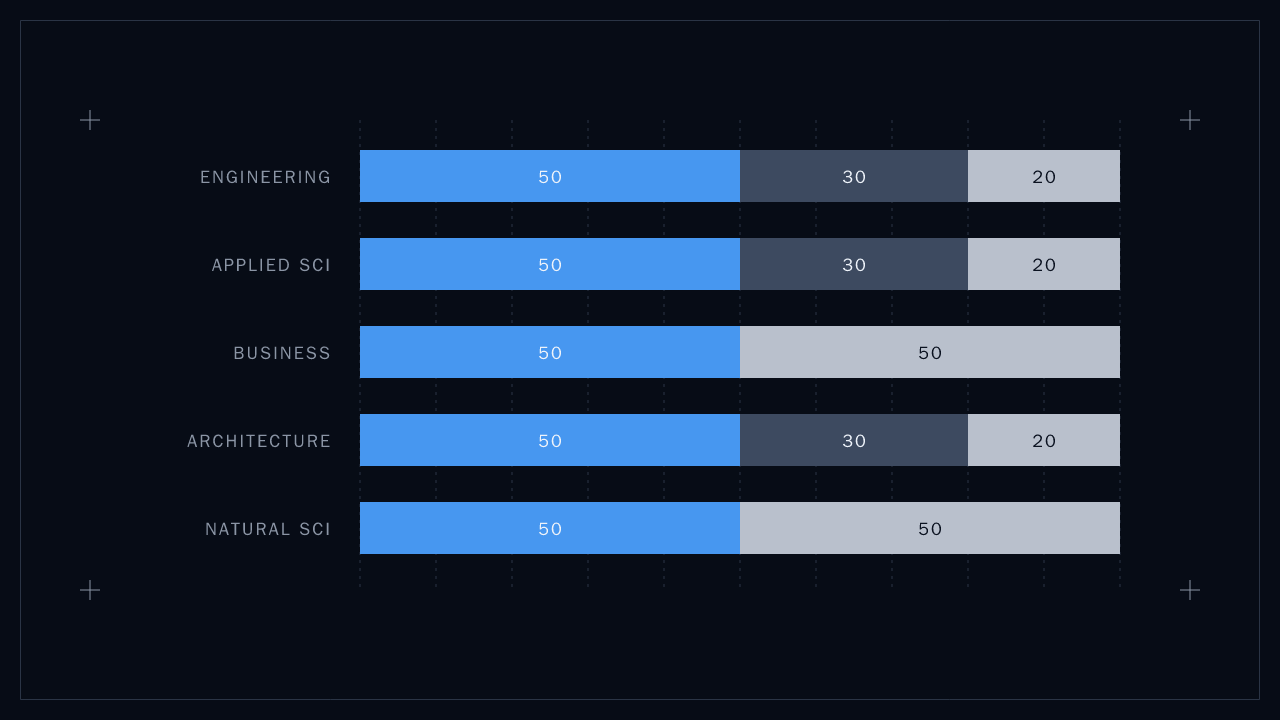
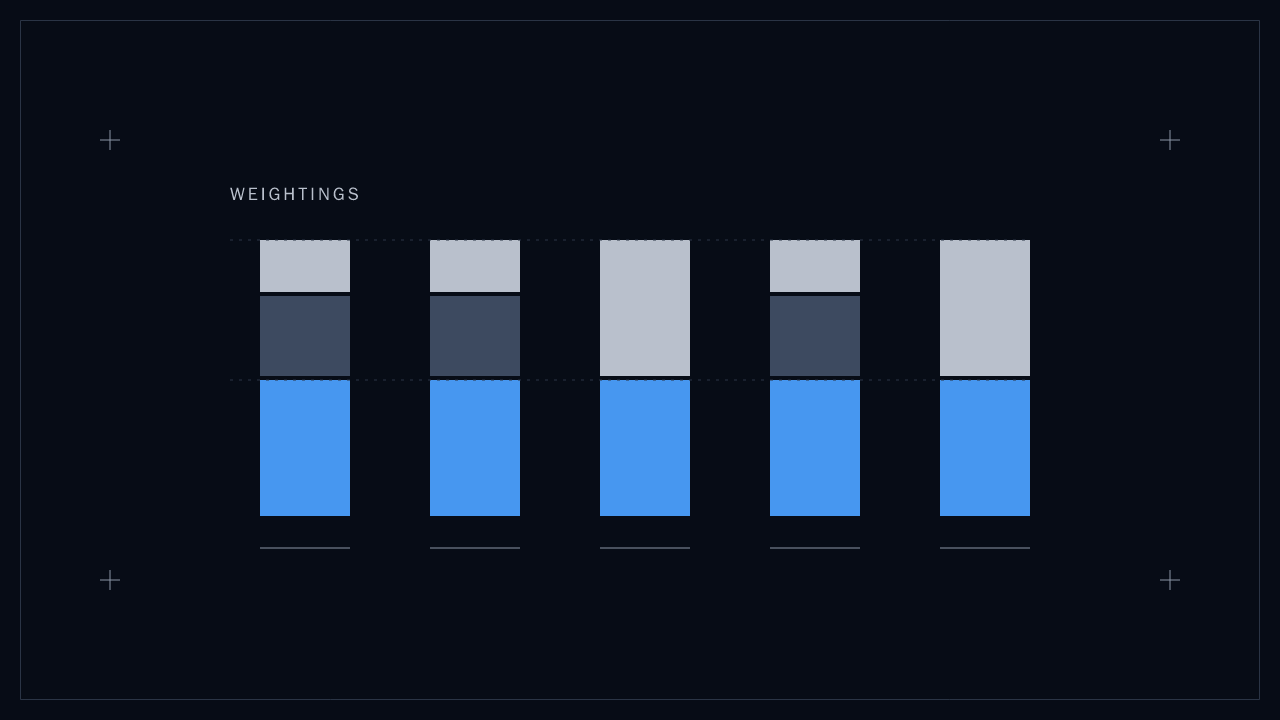
NET-Engineering is Mathematics 50%, Physics 30% and English 20%, drawn from the FSc Part-1 and Part-2 textbooks. Two other common papers swap the subjects: Applied Sciences is Biology 50%, Chemistry 30%, English 20%, and Business is Quantitative Mathematics 50%, English 50%.
Those are NUST's published weightings for the 200-MCQ test. Pick your paper from the table below, then work through its chapter list. NUST directs candidates to the relevant HSSC textbooks. An online practice bank is a supplement, not a limit on what you should study.
Turn the list into a revision record
Mark topics as covered, uncertain or not yet studied. Revise prerequisites before building on them, and use questions to check whether "covered" means you can actually apply the idea.
Do not convert an unofficial high-yield list into permission to ignore the rest. NUST does not promise a fixed number of questions from each chapter. The largest chapter in a question bank is not necessarily the largest part of the exam.
Use the subject weights for overall planning and your own errors for the next session. Keep the full syllabus visible even when a close test date requires prioritising selected gaps.
Choose the correct subject split
| Paper | Subjects and weightings | For |
|---|---|---|
| NET-Engineering | Mathematics 50%, Physics 30%, English 20% | Engineering and Computing programmes |
| NET-Applied Sciences | Biology 50%, Chemistry 30%, English 20% | Pre-Medical candidates for BS Biotechnology, Environmental Science, Agriculture, Food Science, Bioinformatics, Chemistry, Physics |
| NET-Business Studies & Social Sciences | Quantitative Mathematics 50%, English 50% | BBA, Economics, Mass Communication, Psychology, Accounting & Finance, LLB and the other social science degrees |
| NET-Architecture | Design Aptitude 50%, Mathematics 30%, English 20% | B Architecture and B Industrial Design only |
| NET-Natural Sciences | Mathematics 50%, English 50% | BS Mathematics, Physics or Chemistry, for candidates outside the standard streams |
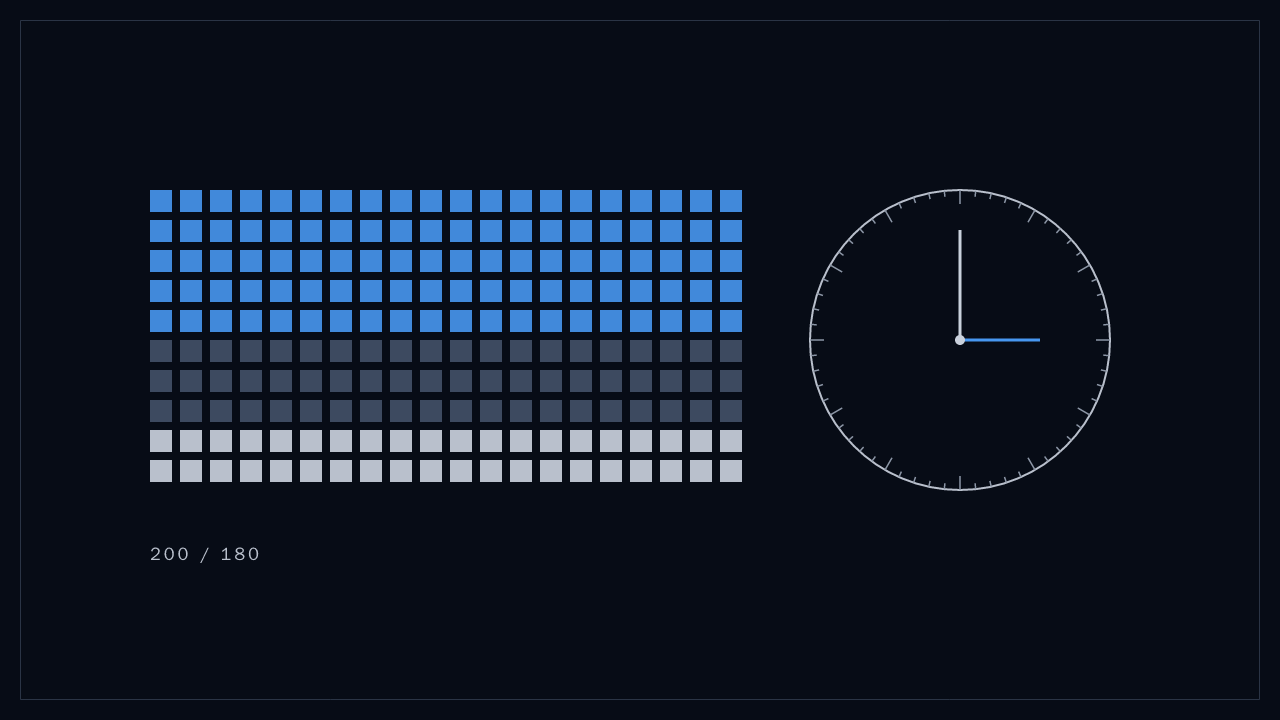
NET is 200 MCQs. If you apply the weightings to 200, NET-Engineering works out to about 100 Mathematics, 60 Physics and 40 English questions. That split is derived, not published. NUST only publishes the percentages. Read which NET paper to take if you are unsure of yours.
Chemistry does not appear in NET-Engineering at all. Pre-Engineering students spend a lot of hours on organic chemistry for boards. None of it is tested on the Engineering paper.
Mathematics checklist
Mathematics is half of NET-Engineering and Natural Sciences, and 30% of NET-Architecture.
| Year | Chapters |
|---|---|
| Part-1 | Complex Numbers, Functions and Graphs, Theory of Quadratic Functions, Matrices and Determinants, Partial Fractions, Sequences and Series, Permutations and Combinations, Mathematical Induction and Binomial Theorem, Division of Polynomials, Trigonometric Identities, Trigonometric Functions and Their Graphs, Limit and Continuity, Differentiation, Vectors in Space |
| Part-2 | Graphical Representation of Functions, Further Differentiation, Integration, Differential Equations, Analytical Geometry, Conic Section, Kinematics, Numerical Method, Inverse Trigonometric Functions and Their Graphs, Solution of Trigonometric Equations, Vector Valued Functions and Their Differentiation |
Calculus runs across both years. Differentiation and integration are where we would start, because nearly every other chapter leans on them.
Physics checklist
Physics is 30% of NET-Engineering.
| Year | Chapters |
|---|---|
| Part-1 | Measurements, Force and Motion, Circular and Rotational Motion, Work, Energy and Power, Solids and Fluid Dynamics, Heat and Thermodynamics, Waves and Vibrations, Physical Optics and Gravitational Waves, Electrostatics and Current Electricity, Electromagnetism, Special Theory of Relativity, Nuclear and Particle Physics |
| Part-2 | Thermal Physics, Simple Harmonic Motion, Physical Optics, Electrostatics, Alternating Current, Quantum Physics, Nuclear and Particle Physics, Medical Physics, Space and Environment |
Practise by chapter from physics practice.
Chemistry checklist
Chemistry is 30% of NET-Applied Sciences.
| Year | Chapters |
|---|---|
| Part-1 | Periodic Table and Periodic Properties, Atomic Structure, Chemical Bonding, Stoichiometry, States and Phases of Matter, Chemical Energetics, Reaction Kinetics, Chemical Equilibrium, Acid-Base Chemistry, Electrochemistry, Hydrocarbons, Nitrogen and Sulfur, Halogens, Atmosphere, Basic Separation Techniques, Lab Safety and Practical Skills |
| Part-2 | Group 2 Elements, Transition Metals, Basics of Organic Chemistry, Aromatic Hydrocarbons, Halogenoalkanes, Hydroxy Compounds, Carbonyl Compounds and Carboxylic Acids, Organic Nitrogen Compounds, Organic Synthesis, Polymers, Biochemistry, Chromatography, Spectroscopy-1, Spectroscopy-2 NMR, Materials and Energy, Medicine, Agriculture and Industry, Water |
Stoichiometry is the chapter to fix first. Mole calculations turn up inside equilibrium, electrochemistry and organic questions too.
Biology checklist
Biology is 50% of NET-Applied Sciences, the single biggest block on that paper.
| Year | Chapters |
|---|---|
| Part-1 | Biodiversity and Classification, Bacteria and Viruses, Cells and Subcellular Organelles, Molecular Biology, Enzymes, Bioenergetics, Structural and Computational Biology, Plant Physiology, Human Digestive System, Human Respiratory System, Human Circulatory System, Human Skeletal and Muscular Systems |
| Part-2 | Thermoregulation and Osmoregulation, Human Urinary System, Human Nervous System, Human Endocrine System, Human Reproductive System, Inheritance, Chromosome and DNA, Biotechnology, Immunity, Biostatistics, Pharmacology, Evolution, Ecology |
Practise by chapter from biology practice.
English and Quantitative Mathematics
English is on every paper, from 20% on Engineering to 50% on Business and Natural Sciences. NUST's FAQ says the English paper follows the SAT pattern. It is not tied to an FSc English textbook. Our English section splits it into three areas: vocabulary, analogies, and grammar and usage.
Quantitative Mathematics is 50% of the Business paper. It covers algebra and factorisation, trigonometry, geometry, matrices, functions, sets and number systems, logs, probability and averages. Practise it at quantitative maths.
Design Aptitude guidance
Design Aptitude is half of NET-Architecture. It is not in any FSc textbook. NUST's weightings page links to Design Aptitude guidelines on the SADA website (sada.nust.edu.pk), and that is the only official source on what the section contains. Read it before you prepare.
Your next step
Confirm your category with the paper guide. Use chapter practice to test the topics you have revised and the three-month plan to organise a sustainable routine.
For current subject rules, return to NUST's official weightings. Do not rely on an old preparation book to identify a changed paper.
Sources and scope
- Five NET papers, each with published subject weightings
- Questions come from HSSC Part-1 and Part-2 level studies
Source: NUST subjects included in NET with weightings page and UG FAQ, checked October 2026